Article
Is the leak coming from the roof or the rooftop HVAC unit?
If it only leaks when it rains, it is usually the roofing around the unit. If it leaks on dry days while the air conditioning runs, it is usually the unit's drain line.
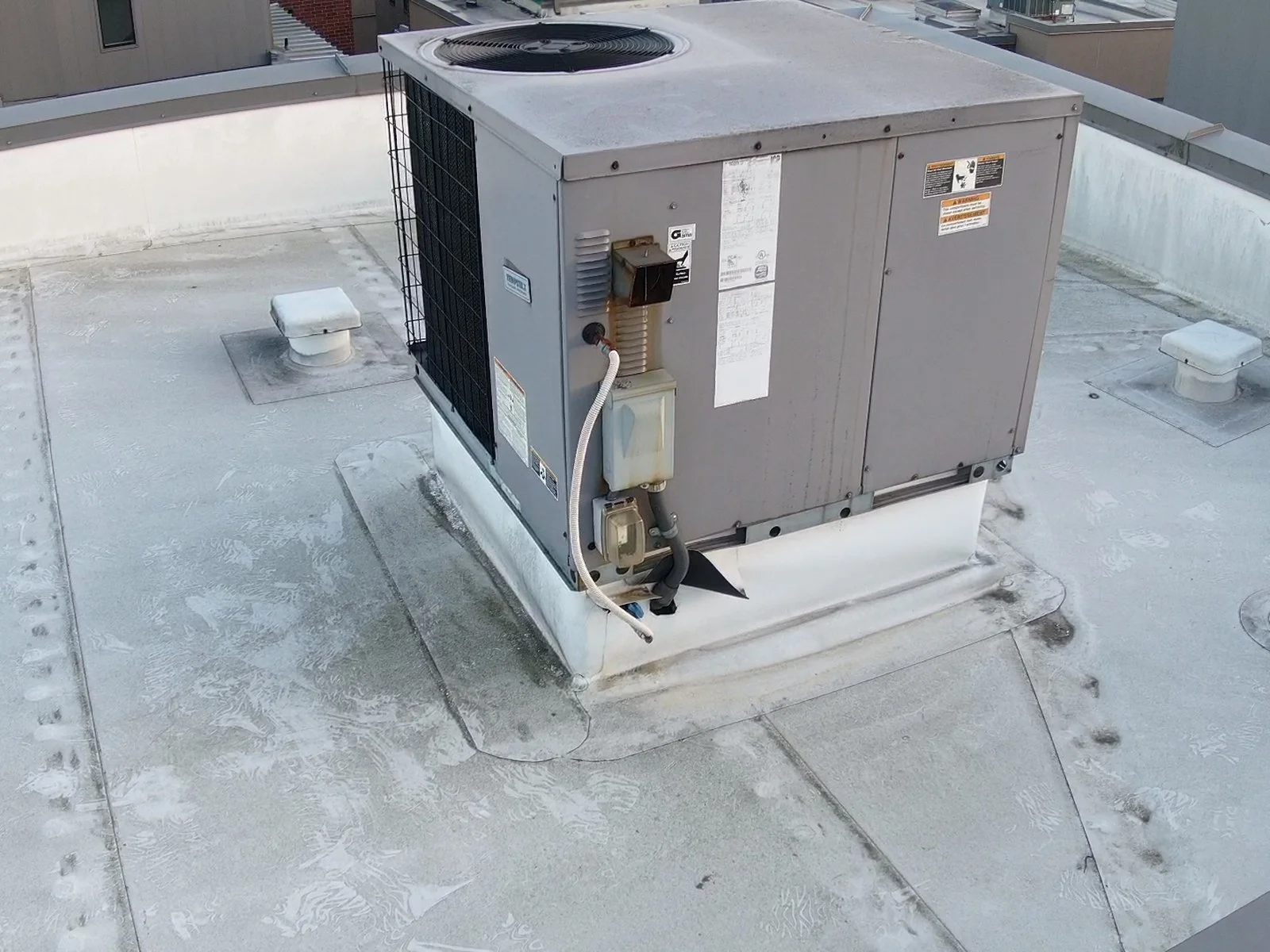
It depends on when it leaks. Rain leaks usually come through the roofing around the unit: the flashing that wraps up the curb the unit sits on. Leaks on dry days, while the air conditioning runs, usually come from the unit’s condensate drain. That is work for your HVAC contractor, not a roofer.
Timing is a strong clue, not proof. A unit can let rain in too, and a leak at the curb can keep dripping for days after the rain stops. To know for sure, someone has to get on the roof and look at the curb, the flashing, and the unit’s drain.
Why the roof and the unit leak in the same place
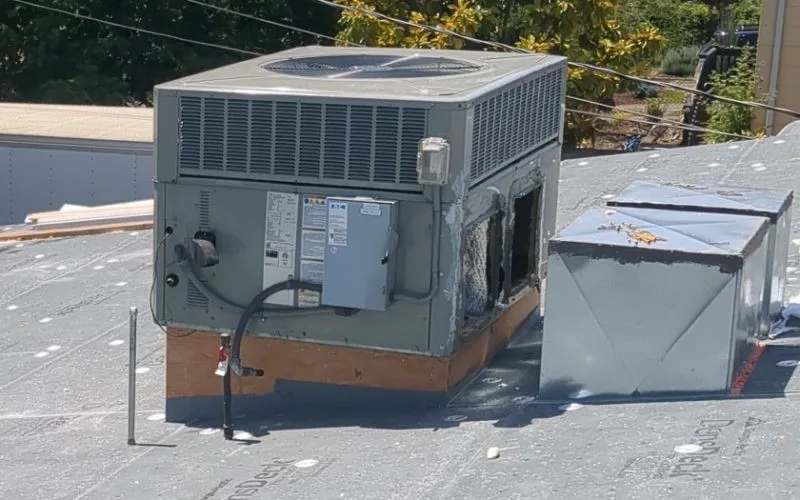
A packaged rooftop unit, the kind that heats and cools a store or an office from the roof, sits on a curb. The curb is a raised box, metal or wood, built around a hole cut through the roof deck. The unit’s supply and return ducts drop through that hole into the building. The gas line and the electrical feed usually come up to the unit on the roof and go in at the side.
That puts two separate watertight systems on top of the same hole:
- The roofing. The membrane runs up the sides of the curb and is sealed there, with metal flashing covering the top edge. The National Roofing Contractors Association recommends that flashing reach at least 8 inches above the finished roof, so standing water and splashing rain stay below the top.
- The unit. Its cabinet panels, the hood over its fresh-air intake, the gasket between the unit and the curb, and the pan and line that carry away the water the cooling coil pulls out of the air.
Water that gets past either one ends up in the same place: inside the curb, then down through the hole in the deck. From the ceiling below, a leak through the roofing and a leak through the unit can look exactly alike.
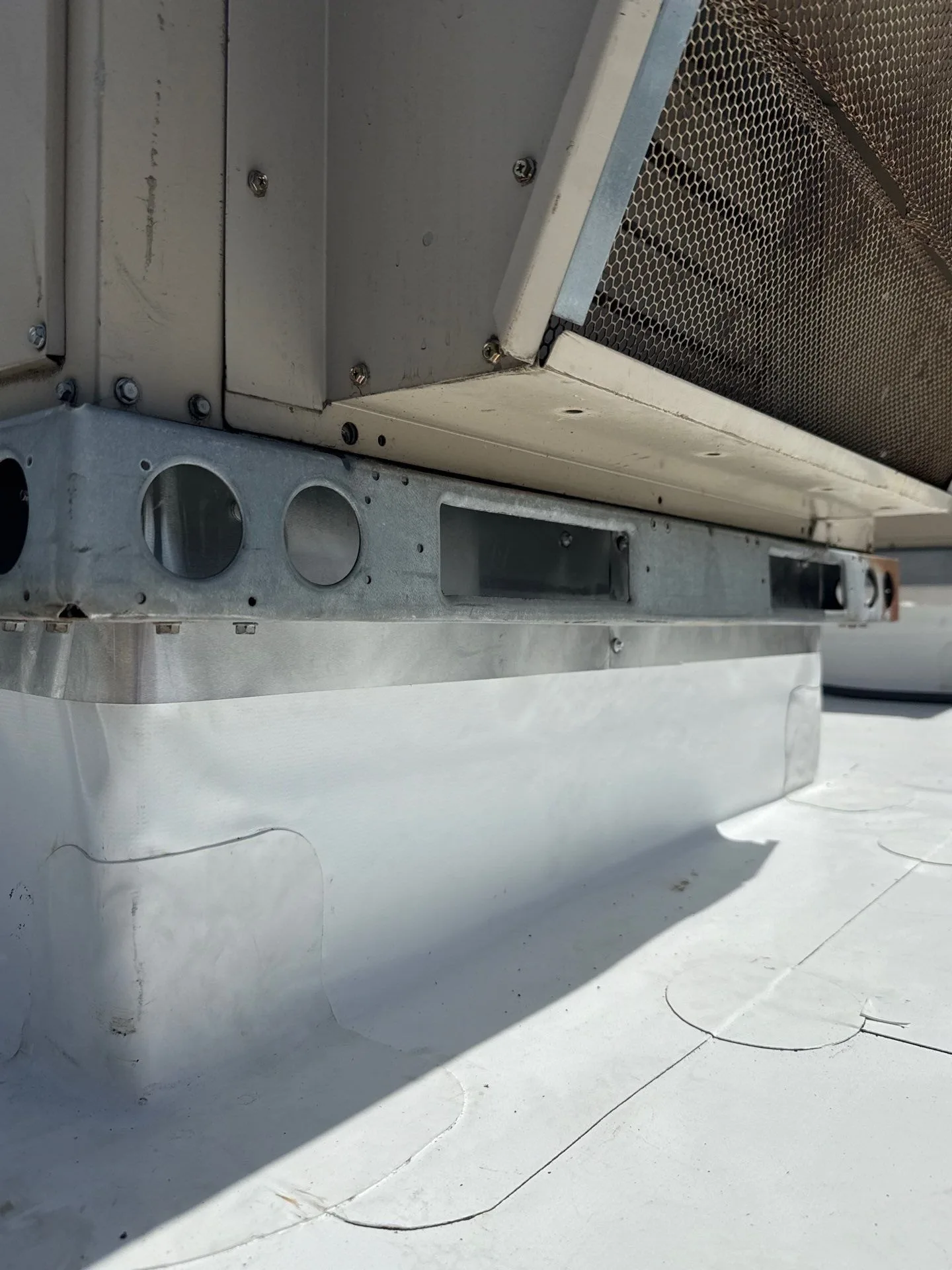
Where the roofing around a unit leaks
Curb flashing fails at the same few places, and all of them leak when it rains.
- The corners. Membrane has to be folded or patched to turn a corner on a curb. Those corner pieces are where the flashing most often opens up.
- The seam at the bottom, where the curb flashing joins the roof membrane. Water sits against it in every storm.
- The top edge. If the metal flashing over the top has come loose, or was never there, rain runs down behind the membrane.
- Holes cut for lines. When a gas line, conduit, or refrigerant line is run through the curb, the flashing is cut to let it in. If nobody seals around it, rain goes straight into the curb.
- Water held against the curb. On the uphill side, a curb acts like a dam. Water stands against it after rain, over the corners and the bottom seam.
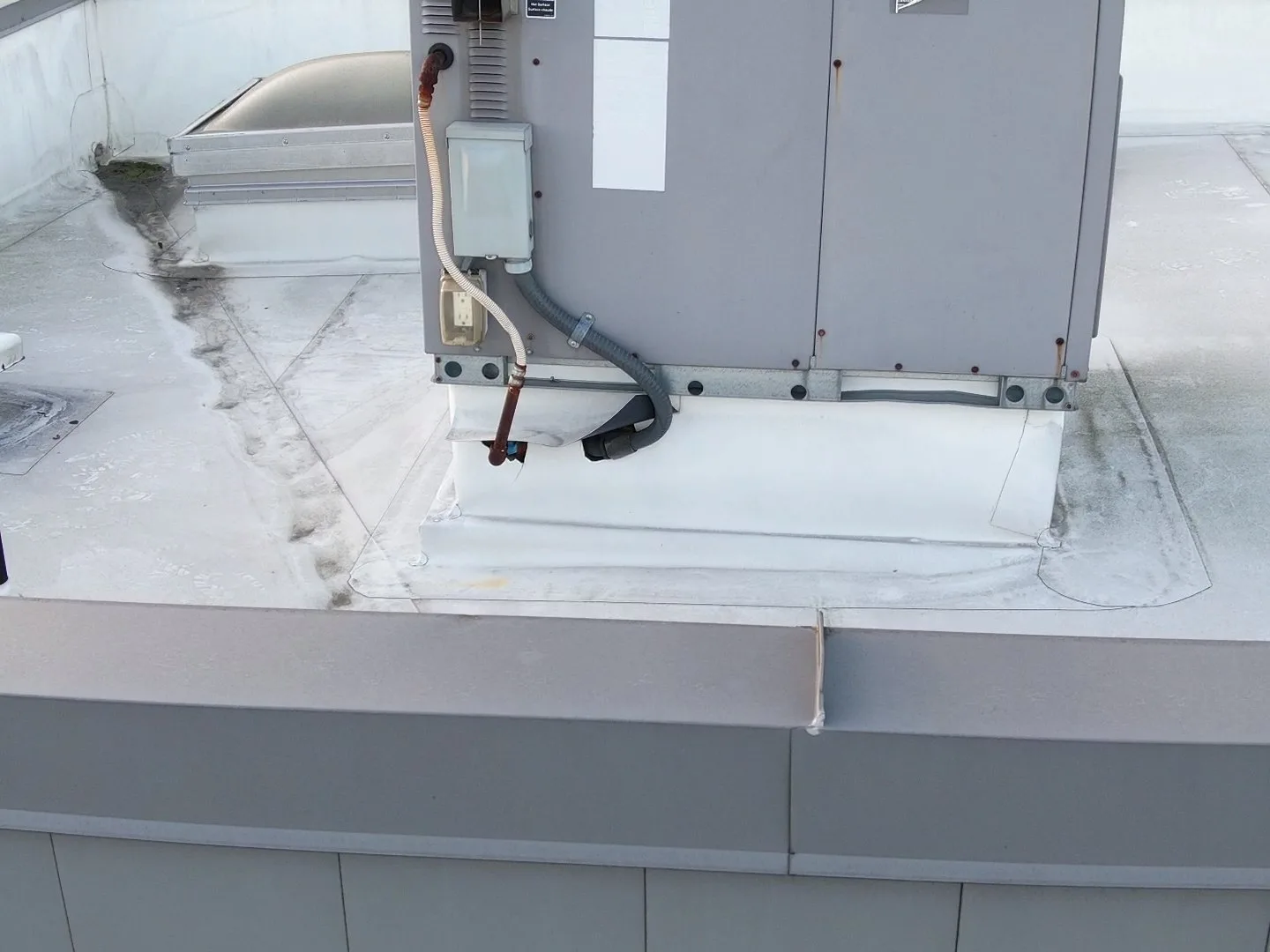
A curb leak rarely starts big. Water gets in at a corner or a cut, soaks the insulation and the deck around the curb, and only reaches the ceiling once they are saturated. The wet spot inside may be several feet from the unit. Why does my flat roof keep leaking in the same spot? explains how water travels under a flat roof before it shows.
Where the unit itself leaks
The condensate drain. When a unit cools, its coil pulls water out of the air. That water collects in a drain pan and runs out through a trap and a drain line, usually onto the roof or to a roof drain. As York puts it, when the trap is not maintained and clogs, the pan overflows, and the water “can potentially go through the roof curb and penetrate the building.” That water comes in on warm days with the cooling on, rain or not. In the Pacific Northwest, where summers are dry, a leak under a rooftop unit on a dry July afternoon is almost never the roofing.
Rain getting into the unit. A missing access panel, a damaged cabinet, or a fresh-air hood that lets wind-driven rain in can put water inside the unit, above the curb flashing. That leak follows rain like a roof leak does, but no amount of work on the roofing will stop it. It often shows up as water dripping from a supply grille or a ceiling diffuser rather than as a stain around the curb opening.
Diagnosing the drain pan, the trap, the cabinet, and the ductwork is HVAC work. What a roofer can tell you is whether the roofing around the unit is sound. If it is, and the water still comes in, the source is on the unit’s side of the line.
Telling them apart
Probably the roof:
- It leaks only when it rains.
- The stain is around the edge of the ceiling opening under the unit.
- The stain is a few feet from the unit and only shows up in rain.
Probably the unit:
- It leaks on dry, warm days while the cooling is on.
- It stops when the unit is switched off, rain or not.
- Water drips from a ceiling vent or grille.
One case sits in between: rain getting into the unit. It follows the rain like a roof leak, but it usually drips from a vent.
To confirm it, a roofer goes up and checks the curb flashing: the corners, the bottom seam, the top edge, and any cuts around lines. They also feel for soft, wet spots in the roof around the curb. If the roofing is sound, the problem is on the unit’s side, and the HVAC contractor takes it from there.
When FRSG is called to a leak and finds the water coming from the unit rather than the roof, the crew tells you, and your HVAC contractor can go straight to the source.
What years of a curb leak do to the roof
A curb leak that goes unfixed does not stay at the curb. The deck and insulation around the unit stay wet season after season, and the wood rots.
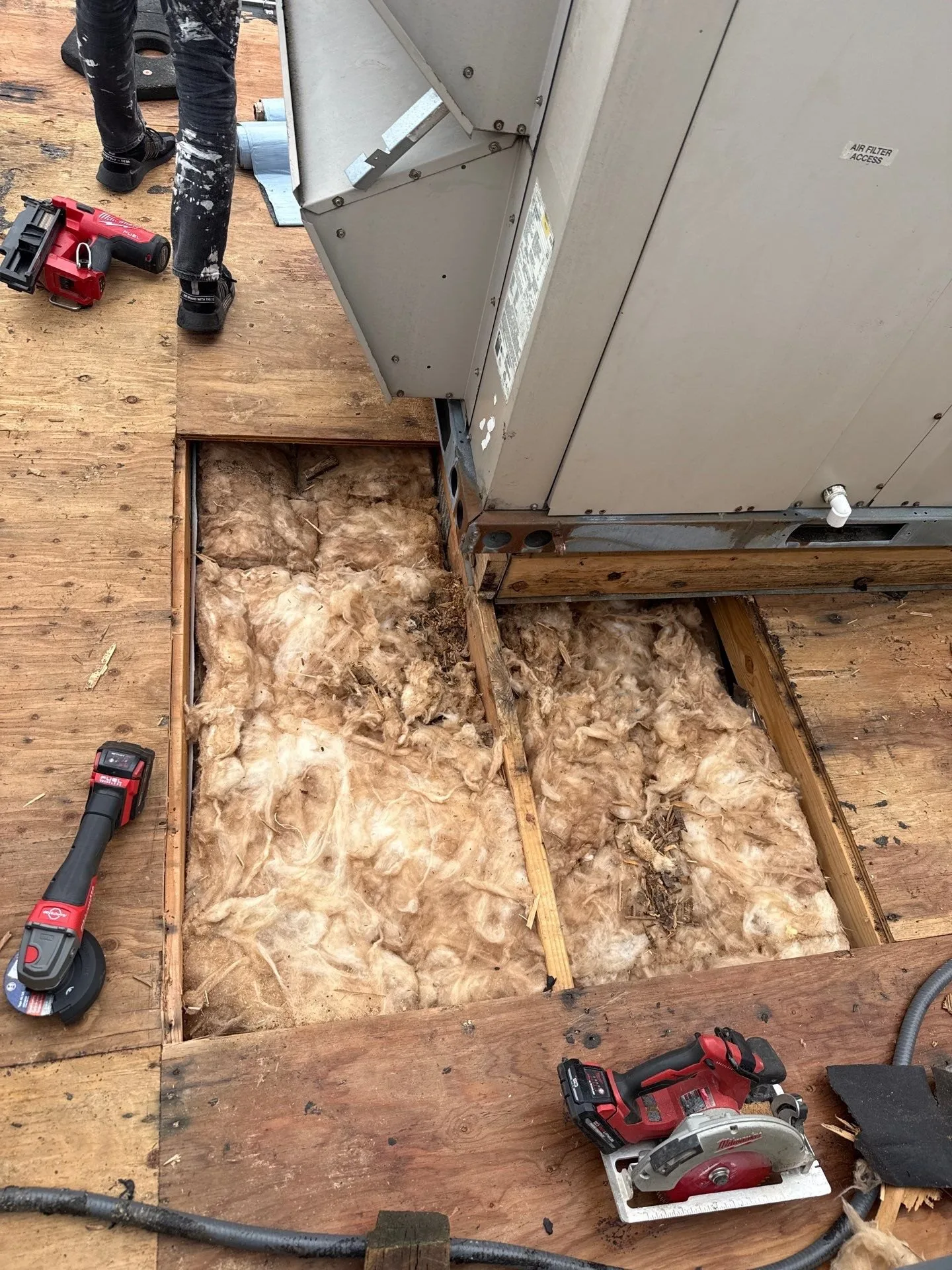
This is why a slow leak at a unit is worth chasing down in its first season. Resealing a corner or a cut is a small Roof Repair. Once the deck under the unit has rotted, the fix means cutting out and replacing the wood around a unit that is still sitting there.
Why the roof around a unit wears out first
Every service visit walks the same path to the unit. Technicians kneel, set down tools and panels, and drop screws, several times a year for the life of the roof. Membranes get scuffed and punctured around units faster than anywhere else on the roof, and the insulation underneath gets crushed.
Two things protect that area.
Walkway pads. These are thick, textured pads laid over the membrane on the path to each unit and around it, so feet and tools land on the pad instead of the roofing. On single-ply roofs they are heat-welded to the membrane: GAF’s TPO walkway roll, for example, has a raised diamond pattern for grip and smooth edges that weld to the roof, and is made for traffic areas around HVAC units, roof hatches, and access doors. On coated roofs, coating makers sell walkways that become part of the coating, like Gaco’s WalkPad, a silicone walkway finished with quartz granules for traction.
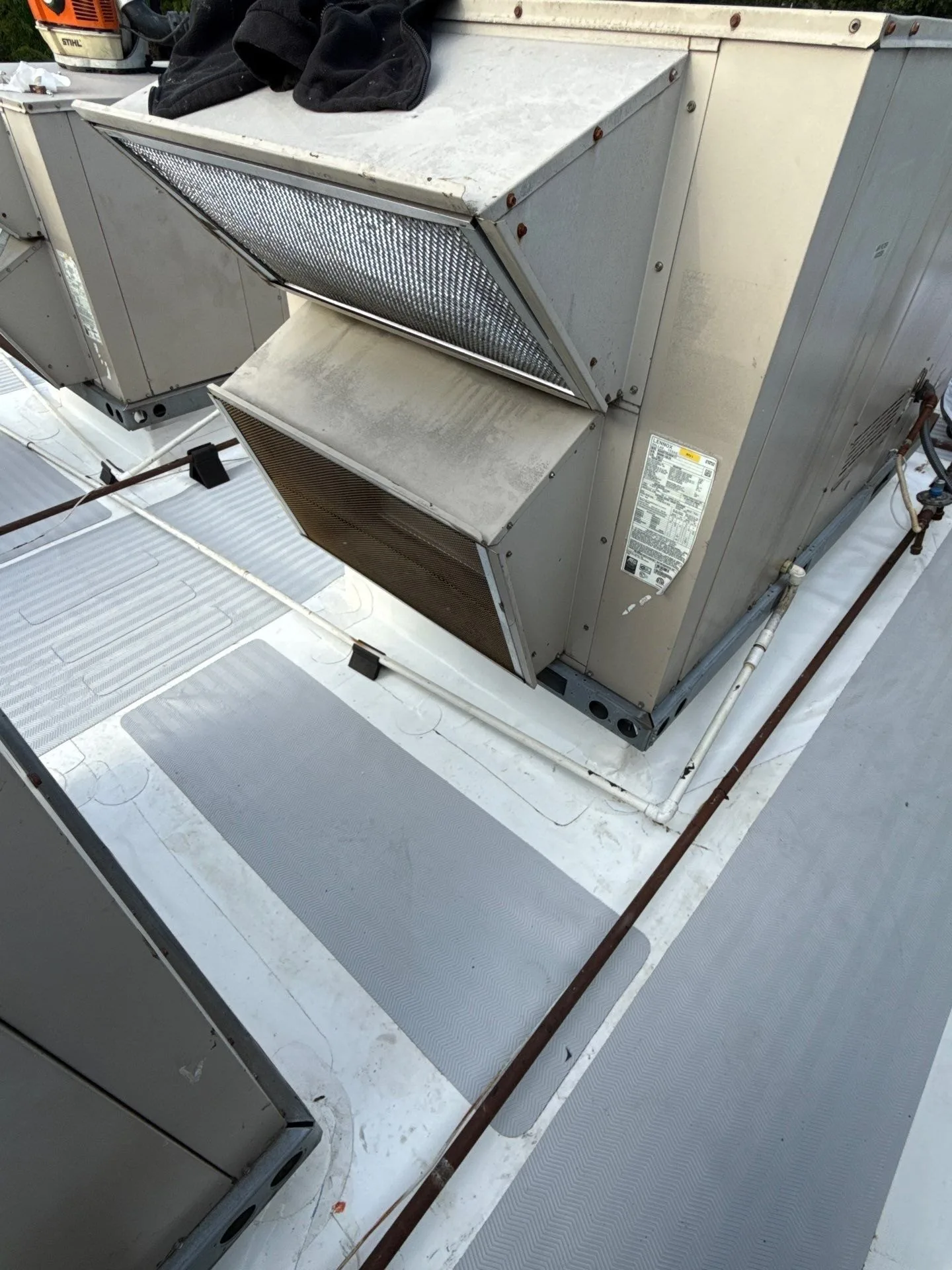
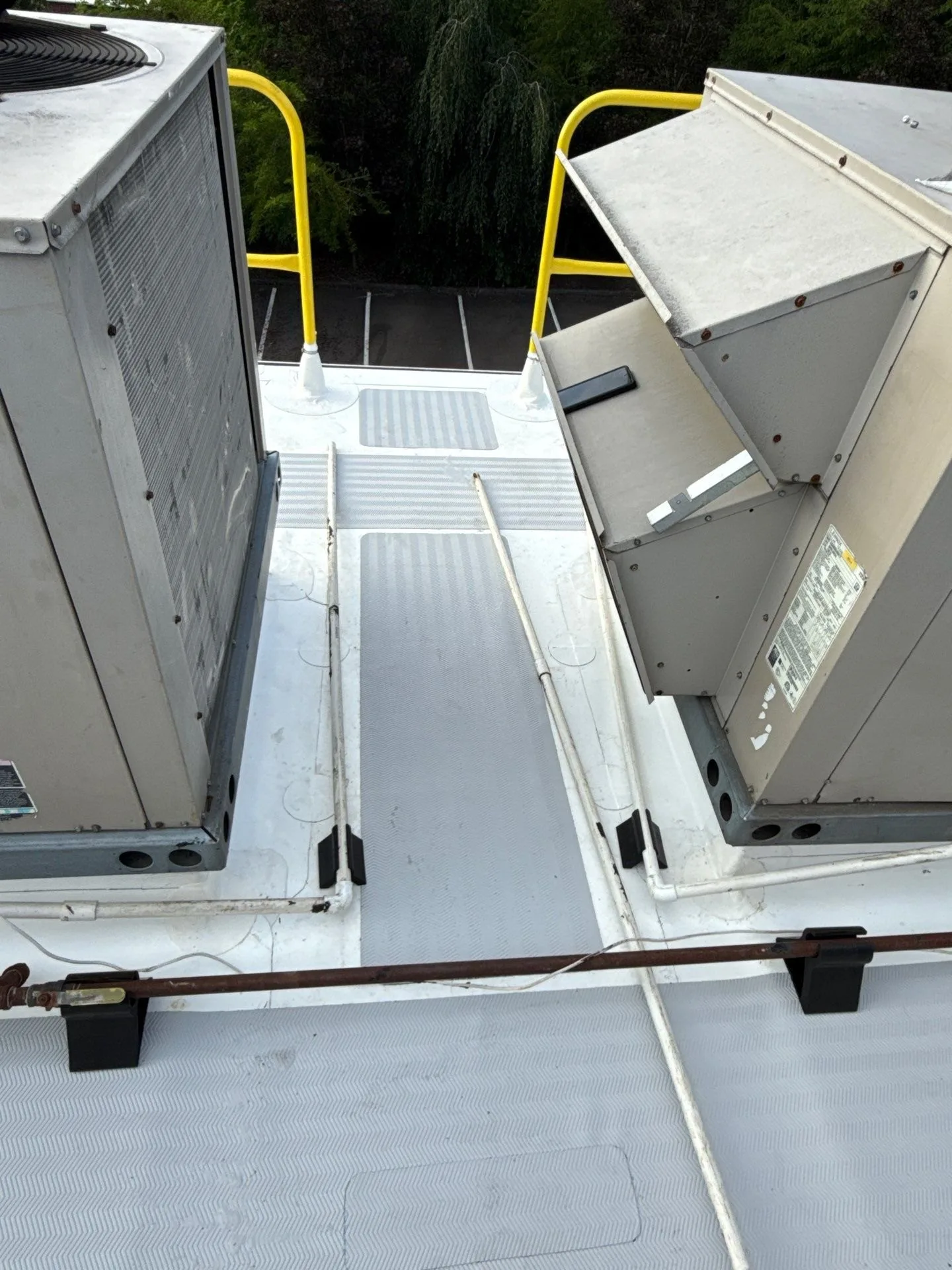
Cover board. On a new roof, a layer of rigid board between the insulation and the membrane spreads the weight of foot traffic. Georgia-Pacific rates its DensDeck Prime roof board at 900 psi compressive strength, and says it keeps foot traffic from crushing the insulation below. In its tests, thermoplastic membranes laid over a quarter-inch of the board were 50 to 70 percent more puncture-resistant than with no cover board at all. Insulation that stays uncrushed around a unit keeps the membrane over it flat and firm, so water does not collect in dents around the curb.
Common questions
It only leaks when the air conditioning is on. Is it the roof?
Almost certainly not. Water that comes in on dry days while the cooling runs is condensate: a clogged trap or drain line is letting the drain pan overflow. Call your HVAC contractor first.
Water is dripping out of a ceiling vent. Who do I call?
Water from a supply grille or diffuser is inside the ductwork, so start with your HVAC contractor. If it only happens in rain and they find the unit closed up and the drain running, have a roofer check the curb.
Who seals the hole where a gas line or conduit goes into the curb?
The opening is in the roofing, so sealing it is roofing work. It should be done with a proper boot or flashing around the line, not caulk. If a gas or electrical line has just been run to a unit, it is worth checking that someone closed the flashing back up afterwards.
Can the condensate line just drain onto the roof?
Many rooftop units drain onto the roof. The problem is a line that drips on the same spot of membrane year after year, or on a spot where water already ponds. Ask your HVAC contractor to route the line toward a roof drain, and ask your roofer whether the membrane where it discharges is holding up.
What should I tell the roofer when I call?
When it leaks: only in rain, or also on dry days. Whether it stops when the unit is off. Where the water comes in: from a vent or grille, around the edge of the curb opening, or a few feet away. Whether anyone has recently serviced the unit, replaced it, or run a new line to it. Photos of the ceiling help, and so does a photo of the unit from the roof if someone can safely get up there.
Thanks for your feedback.
About FRSG
Flat Roof Systems Group (FRSG) is a commercial flat-roof repair contractor serving Property Managers across Oregon and Washington. FRSG stops active leaks, makes permanent Roof Repairs with clear documentation and predictable pricing, and proposes a Full Reroof only when an inspection shows that repairing would cost more than it saves. Every visit ends with a Service Record: the problem reported, the work done, and photographs of the roof as FRSG left it.