Article
What to check on a commercial roof in Vancouver, WA
Start with the drains. We flew 44 commercial roofs in east Vancouver in October: 98% had leaves or debris at drains or edges, and 3 had a drain strainer off.
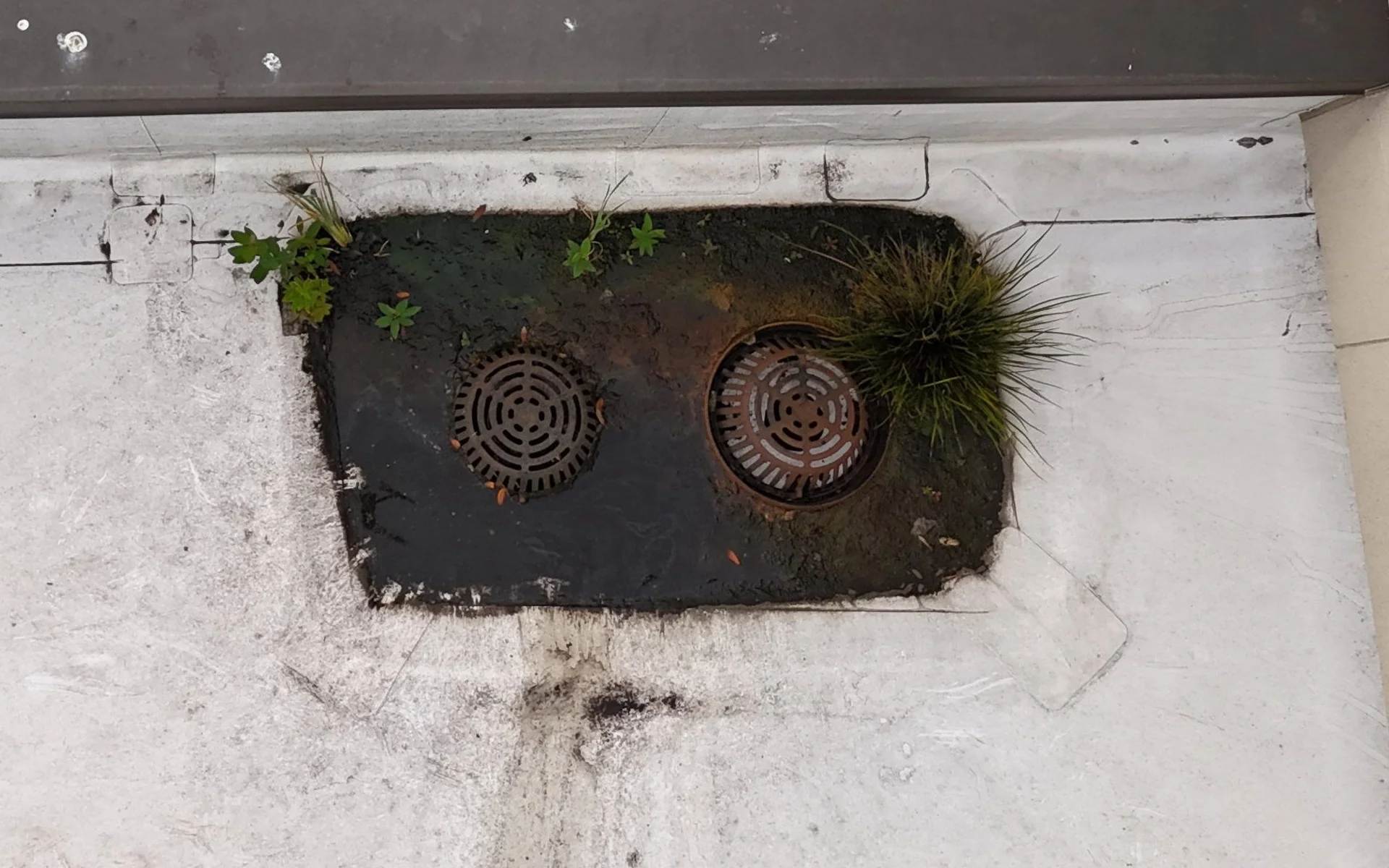
Start with the drains: look for leaves or dirt piled around them, a missing strainer (the dome or basket that keeps debris out of the pipe), and water standing in front of them. Then look for anything left lying on the roof, and at the low walls around its edge. Check before November and December, Vancouver’s two wettest months, and after anyone has worked up there.
In October 2026 we flew a drone over 44 commercial roofs in east and northeast Vancouver, most of them strip malls along Mill Plain Boulevard and north of it. Nearly all of them (98%) had leaves, dirt or debris at the drains, edges or corners, and on two-thirds it sat right where the water drains off. About a third had something left loose on the roof. On three roofs, a drain strainer was sitting on the roof beside its open drain.
None of that shows from the parking lot.
Why the drains come first
A flat roof drains through a few small openings: drains, gutters, and scuppers (openings through the low wall at the edge). Rain carries everything loose on the roof to them. A wet mat of leaves there doesn’t have to block a drain to slow the water down.
Water that can’t get off finds the weak spots: the seams where sheets of roofing join, and the seal around each drain. Why is water leaking around a roof drain? explains that seal. Left long enough, the dirt turns to soil: on two of these roofs, plants had taken root around the drains, like the grass at the top of this page.
Does your roof look like this?
Four things the drone found, and what to do about each.
A drain with its strainer off
On a small retail building on Mill Plain, one drain is open, and the wire basket that appears to be its strainer is sitting on the roof beside it. Leaves have already gone in.
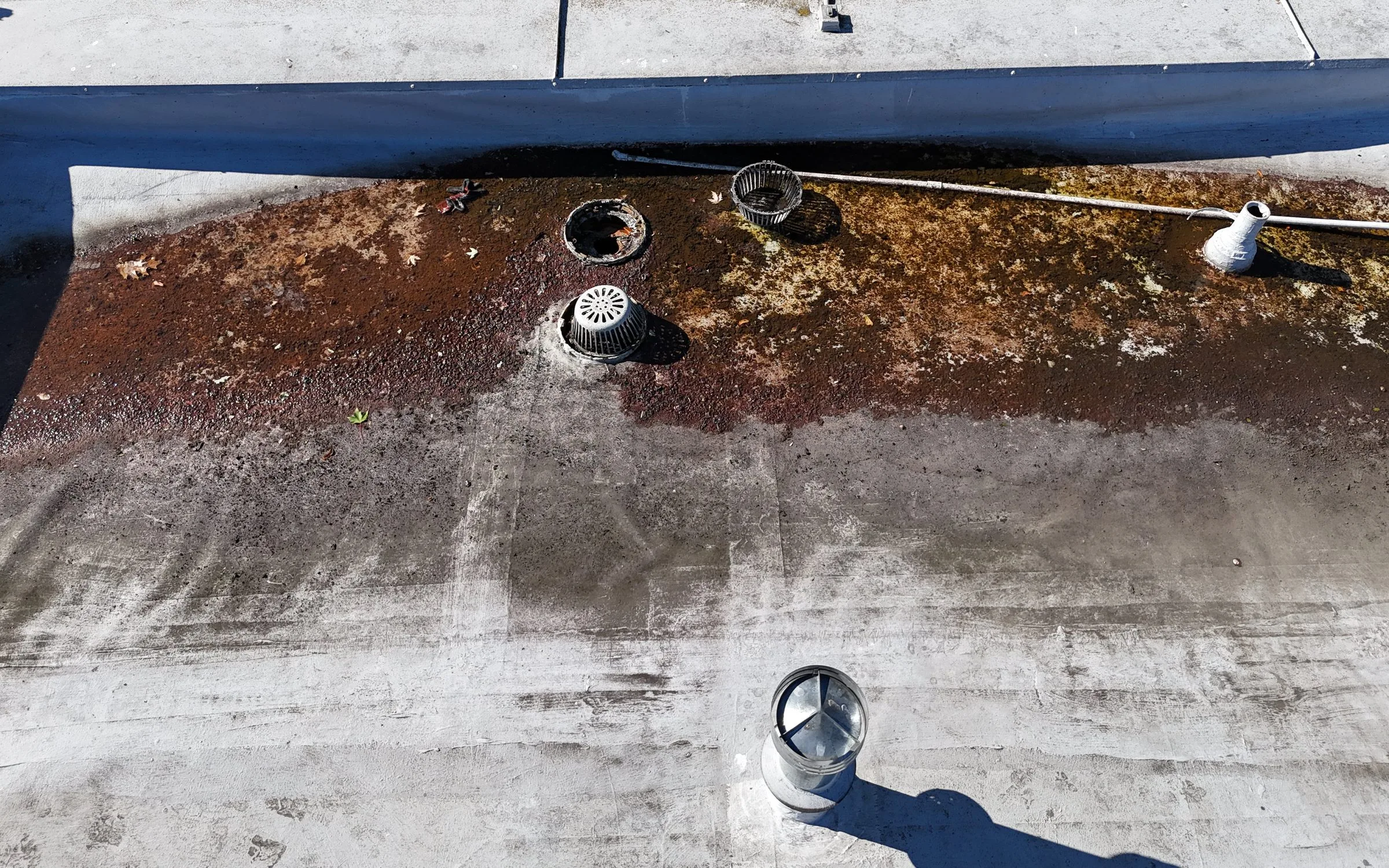
The strainer is the only thing between the roof and the pipe. Without it, leaves and grit wash in and build up where the pipe bends, and a blocked pipe backs water up across the roof.
What to do: clear the debris, put the strainer back, and have the drain checked to be sure it still runs freely.
Water standing in front of the drains
On the same roof, two more drains had their strainers on, and water stood in front of them anyway. So the strainer isn’t the problem: either the pipe is slow, or the drain sits a little higher than the roof around it and the last inch of water can’t reach it.
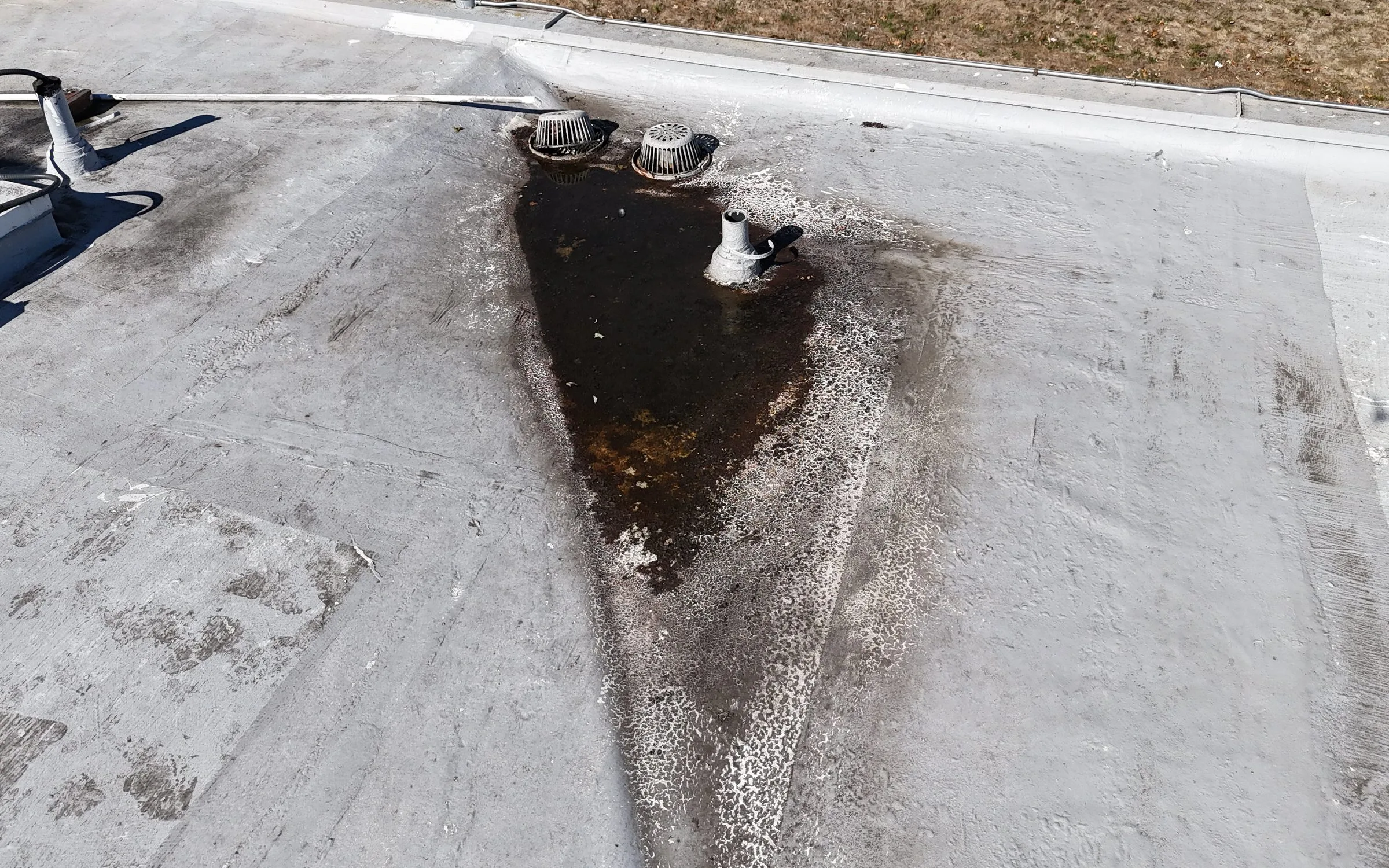
What to do: have the pipe cleared. If the pond is back after the next rain, the spot sits low, and fixing standing water like that is a repair, not a cleaning.
A panel left off a rooftop unit
On a retail building in northeast Vancouver, an access panel was lying on the roof between two rooftop heating and cooling (HVAC) units, and the unit it came from stood open. Rain can get in on its wiring, and wind can lift a loose panel.
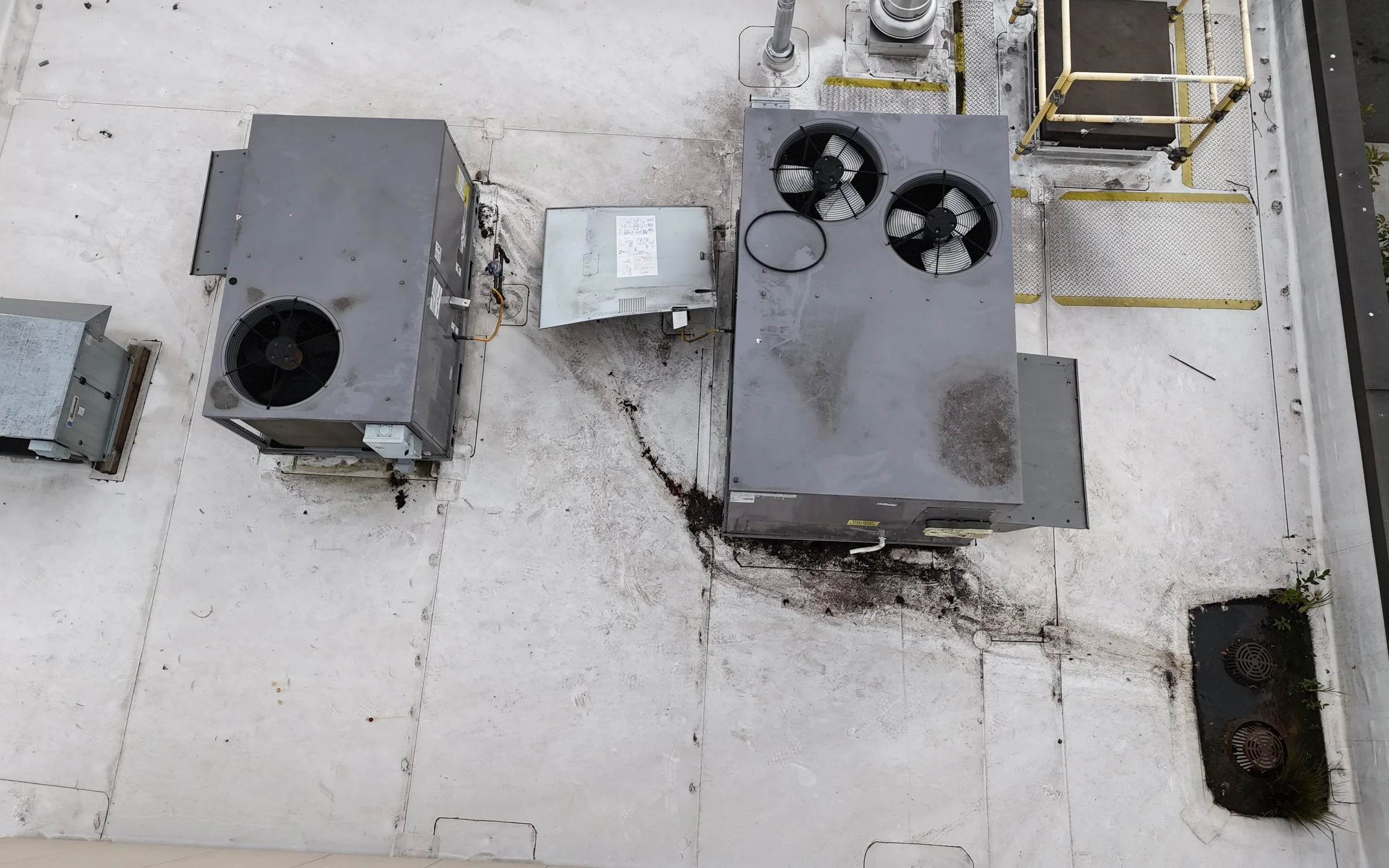
Anything left loose on a roof ends up in the drains, and a screw underfoot can puncture the roofing. About a third of the roofs we flew had something left loose, most often cable or hose.
What to do: ask your HVAC contractor to put the panel back and check the unit; that is HVAC work, not roofing. Then pick up anything else that’s loose.
Bare wood or loose roofing at the edge
On a retail strip on Mill Plain, the inside of the parapet, the low wall around the roof, is bare wood: gray, split, and breaking up where it meets the roof. The roofing should run up that wall and over its top, under the metal cap. Bare wood there soaks up every rain, and water that gets into the wall can travel down inside the building. In the corner, a large sheet of roofing has come loose and folded back, where wind can lift it further.
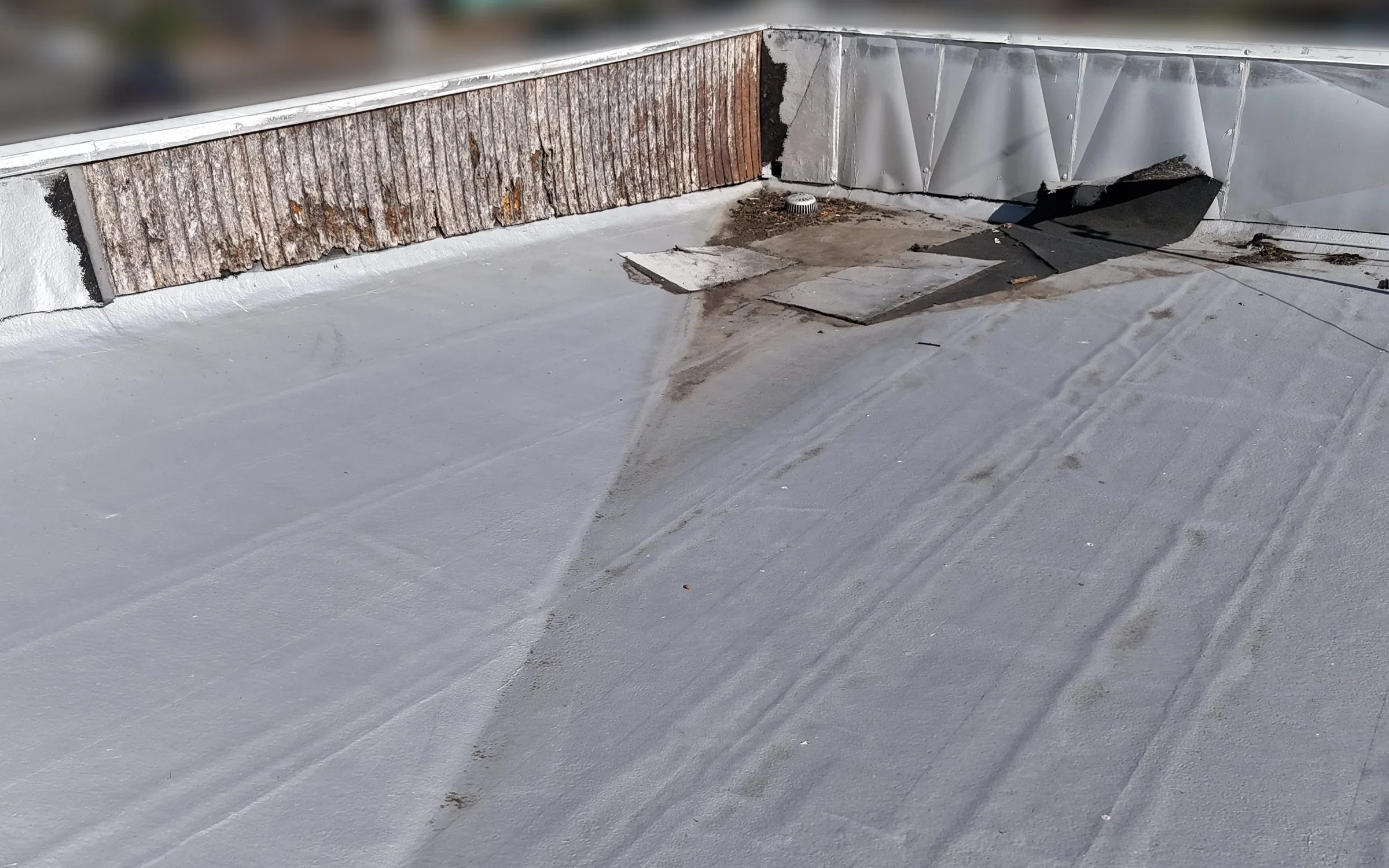
What to do: both are a Roof Repair: replace any soft wood and cover the wall properly, and secure or replace the sheet.
When to check: before the rain, and after any work up there
Before the rain, because NOAA’s 1991–2020 normals put Vancouver’s November at 5.51 inches and December at 6.07, against 0.42 in July. A drain half covered in October gets tested all winter.
After any work on the roof, because roofers aren’t the only people up there. HVAC technicians, plumbers and sign crews work on strip mall roofs too. Ask whoever was up there for photos of the roof before they leave, or have someone go through the list below.
How to check your own roof
Look a day or two after it rains. A puddle gone by then is normal; water still there after 48 hours isn’t draining. From a roof hatch, look from the ladder; don’t walk out onto a wet roof. Look for:
- a strainer on every drain
- leaves, dirt or plants at the drains, in the corners and along the walls
- water standing near a drain
- every panel on every rooftop unit, and nothing left lying around
- bare wood, or roofing lifting, along the walls
- new cuts or scuffs in the roofing around the units
If a leak shows up near a unit after a service visit, Is the leak coming from the roof or the rooftop HVAC unit? explains how to tell which.
What each fix is, and what it costs
- Leaves, dirt or plants at the drains, or a strainer off: a Roof Service visit. A technician clears the drains, scuppers and gutters, hauls off the debris and seals small cracks, with before and after photos. $395 for 2 hours of work, sealant and small patches included.
- Water still standing once the drains are clear, or bare wood or a loose sheet at the edge: a Roof Repair, quoted for the job.
- A panel off a rooftop unit: your HVAC contractor.
- Ridges or cracking across the whole roof, patch over patch, or you want to know how long the roof will last: a Roof Report: a drone map, a walk-on inspection and a core sample, opening with the roof’s years left and its repair and replacement budgets. $395 up to 30,000 sq ft, then $0.01 per extra sq ft.
- Water coming through a ceiling: stop the leak first. Flat roof leaks: what a Property Manager needs to know covers the first steps.
Thinking about a new roof? Check Washington’s insulation rule
A roof with ridges running all the way across it, like the one below, raises the bigger question: repair or replace? In Washington, replacing can bring an insulation requirement that repairing doesn’t.
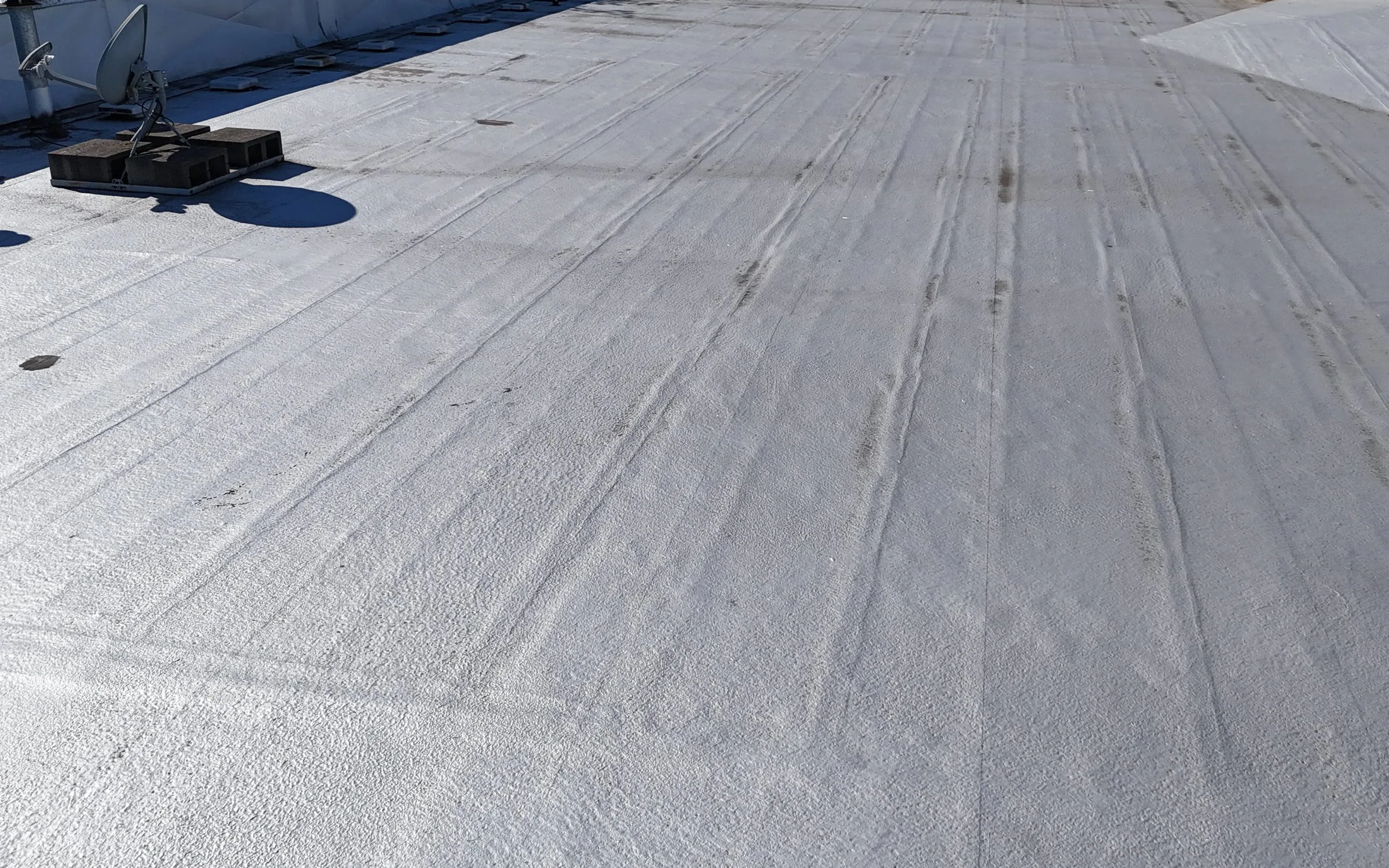
Under the state energy code, tearing off a roof over heated or cooled space means bringing its insulation up to today’s level when the insulation sits entirely on top of the roof deck (the structure the roofing rests on), or there is none. In Clark County that’s R-38, or a roof that insulates as well. That can mean several more inches of board, with the drains, the frames the units sit on and the roofing up the walls raised to match. A repair doesn’t trigger it, and neither does a recover (a new roof laid over the old one), as long as the building’s energy use doesn’t go up.
So before anyone prices a tear-off, find out where your insulation is and how much there is. Commercial roof repair vs. restoration vs. replacement covers the rest of the decision. Expect a permit too, from the City of Vancouver or, outside the city limits, Clark County. These rules are from the 2021 code; a new edition takes effect May 3, 2027.
Can’t see your roof?
Whatever your roof needs, the first step is seeing it. A flat roof behind a parapet can’t be seen from the ground, and often not from anywhere in the building. A free Drone Check shows it to you: we fly a drone over the roof and send you photos and a short summary of what we see, like the ones on this page, but of your own roof. It can’t tell whether there’s water under the roofing or where a leak gets in; that takes someone on the roof.
On these 44 roofs, the most common problem was also the simplest to fix: leaves and dirt sitting where the water needs to leave.
Thanks for your feedback.
About FRSG
Flat Roof Systems Group (FRSG) is a commercial flat-roof repair contractor serving Property Managers across Oregon and Washington. FRSG starts with a free Drone Check, fixes leaks and clears roofs with Roof Service, makes permanent Roof Repairs with clear documentation and predictable pricing, and proposes a Full Reroof only when repairing would cost more than it saves, with RoofCare to look after the new roof for up to 15years. Every repair ends with a Service Record: the problem reported, the work done, and photographs of the roof as FRSG left it.