Article
When to clear leaves off a flat roof in Portland
Twice: in the fall, and again once the trees are bare. We flew 12 flat roofs in Northwest Portland in mid-October: 75% already had leaves at the edges or drains.
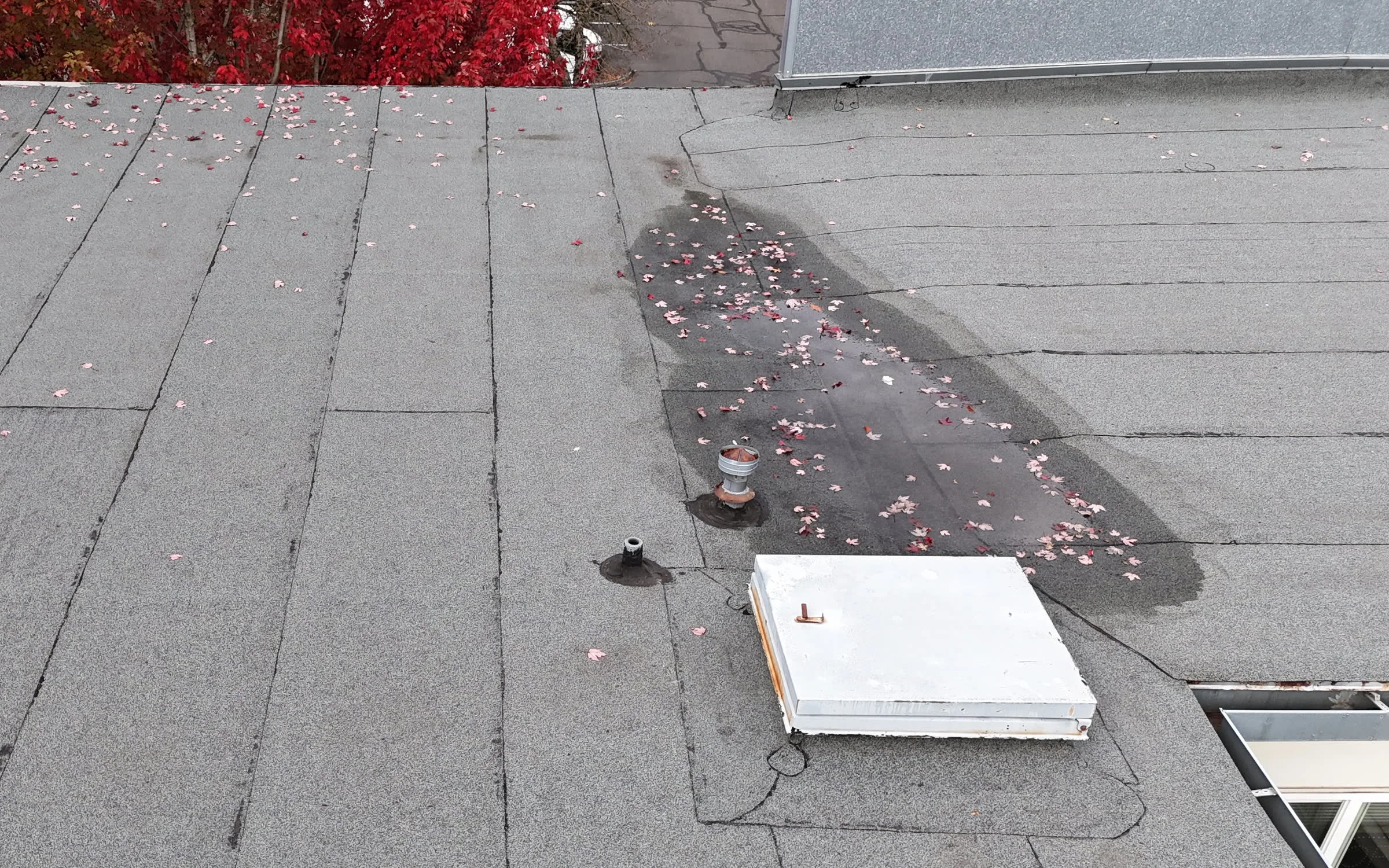
Twice: once in early fall, and again once the trees are bare, usually late November or December. December is Portland’s wettest month, so the second clearing is the one that matters most.
Leaves land on flat roofs earlier than most owners expect. On October 14, 2026, we flew a drone over 13 flat roofs in Northwest Portland, near NW 21st Avenue. One was being reroofed. Of the other 12, three in four (75%) already had leaves along the edges, in corners and gutters, or around the drains. On a third of them, the leaves were at or beside a drain.
If your building has a flat roof and trees nearby, the odds are good it has leaves on it now. From the street, you can’t tell.
None of the 12 roofs looked like it needed replacing. Every one needed its debris cleared or its drains checked.
Why leaves on a flat roof lead to leaks
A flat roof drains through a few small openings: drains in the roof, scuppers (openings through the low wall at the edge) and gutters. A wet mat of leaves doesn’t have to block a drain to slow the water down.
Water that can’t get off stands on the roof and finds the weak spots: the seams where two sheets of roofing join, and the base of walls and vents. That is how leaves on the roof become a stain on a top-floor ceiling. Why is water leaking around a roof drain? explains what it does at the drain.
Does your roof look like this?
Three things the drone found, and what to do about each.
Leaves packed in a gutter
A gutter packed with leaves can’t carry the rain away. The water backs up onto the roof, or spills over and runs down the wall.
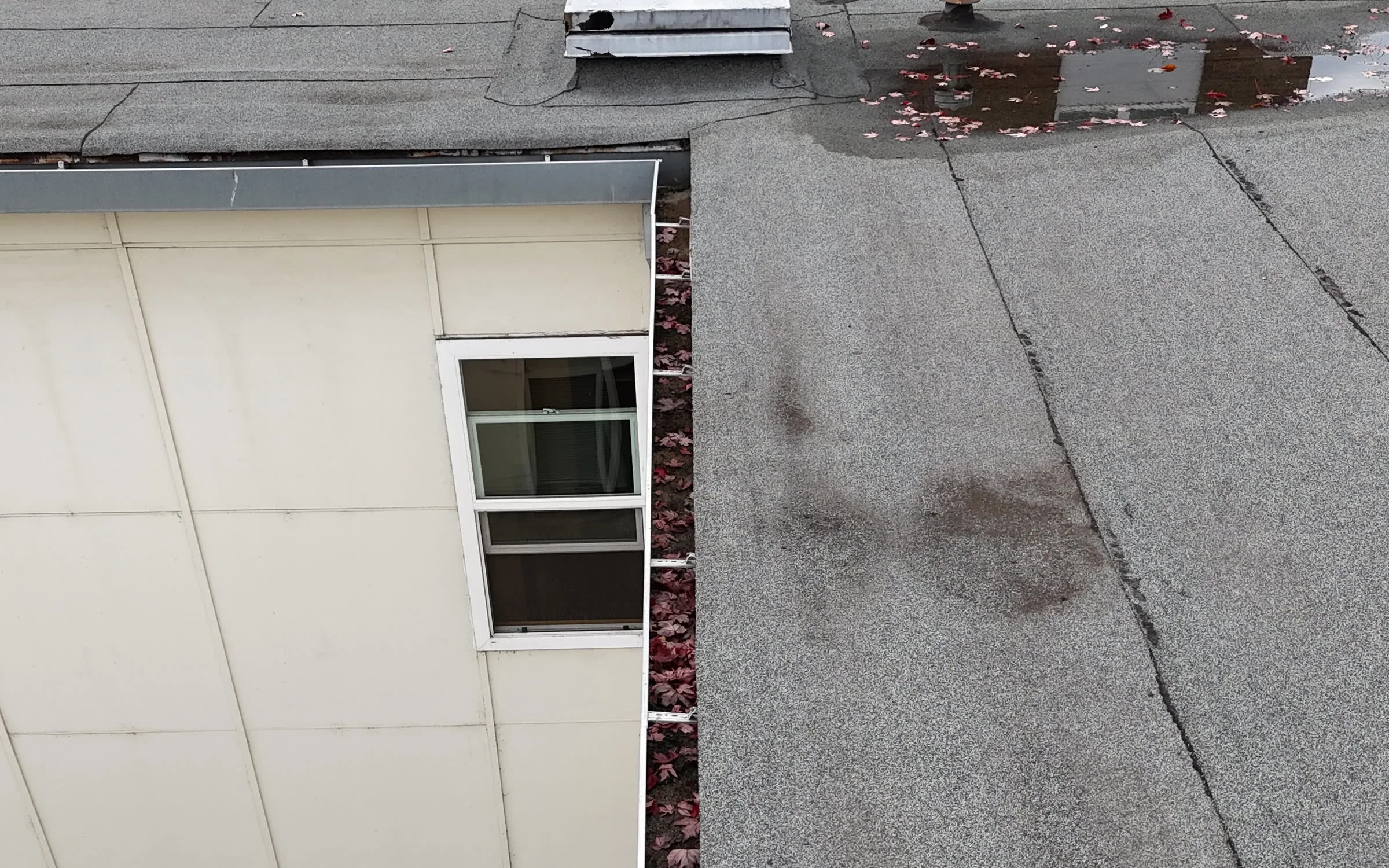
What to do: clear the gutters and the drains, and carry the leaves off the roof so the next rain can’t wash them back in.
Water stopping short of the drain
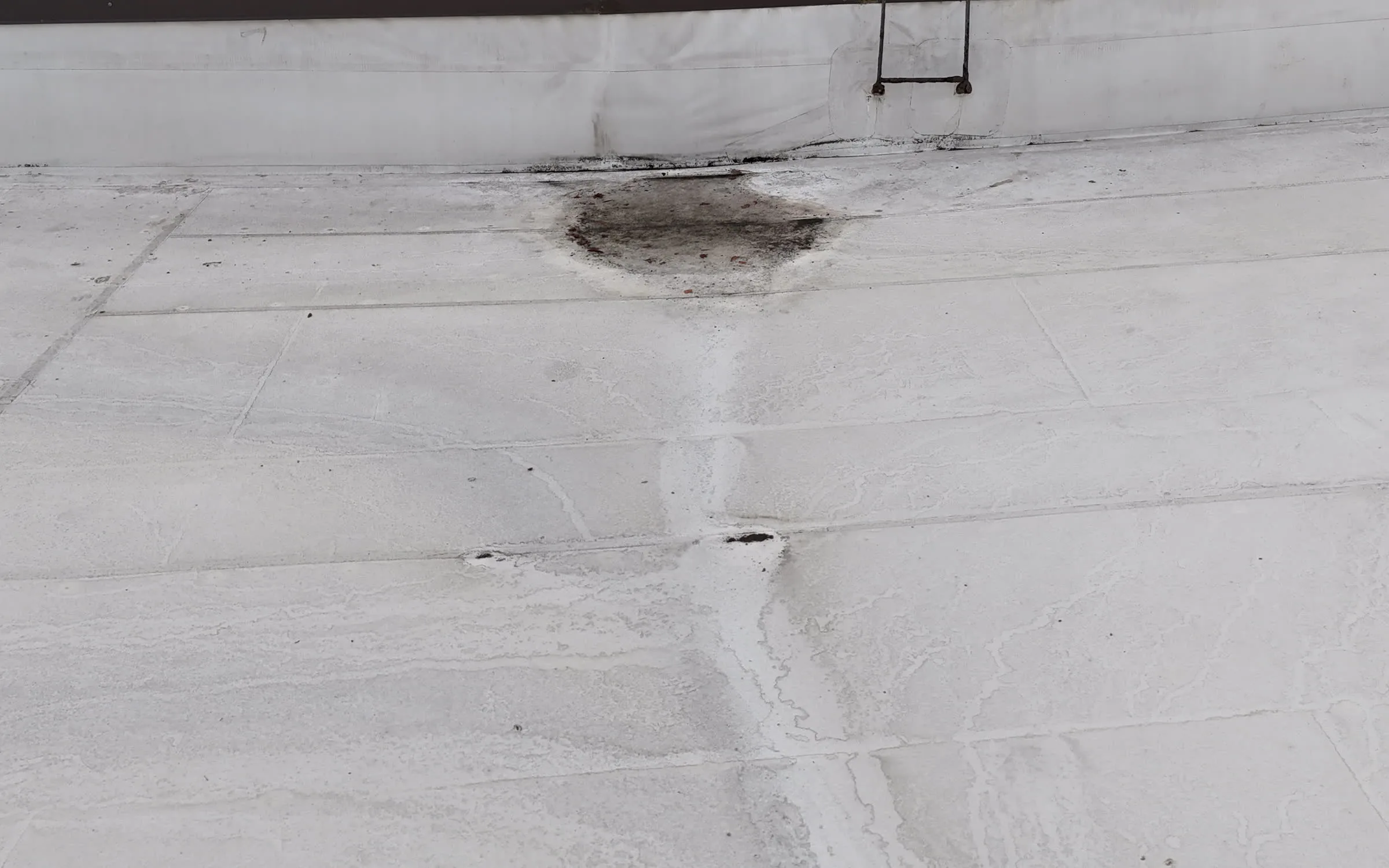
This white roof, on a brick apartment building, was nearly clear of leaves. Its trouble is on the water’s path to the drain. The roofing comes in wide sheets joined at seams, and where the seams cross that path, they have lifted into ridges. The dark patch between two of them is dirt left where the water stops and dries.
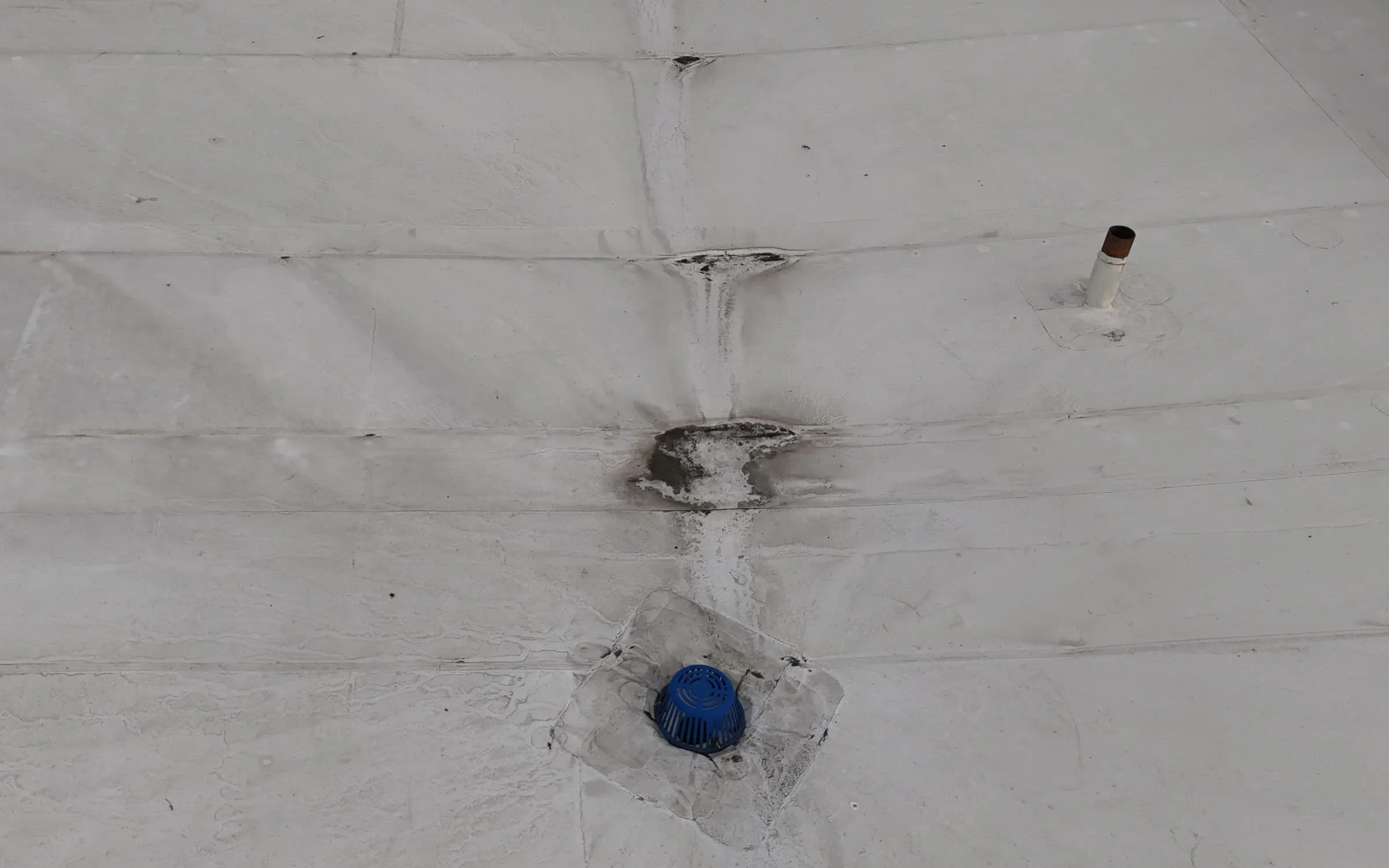
A seam is one of the first places this kind of roof opens, and one with water on it after every rain gets many more chances to leak.
What to do: have a roofer probe the lifted seams to see if they’re still sealed. An open one gets a new piece of roofing welded over it. Why are roof seams opening again after a repair? covers what makes that last.
Water standing in a low corner
This one-story building has a curved roof. Rain runs off the curve to a flat strip along the edge, then along it to the outlets. In this corner the water stays, where several sheets of roofing end. Water that sits in one place wears out the roofing under it. Overall the roof was in decent shape, with debris along the edges, plants over one edge and several old patches.
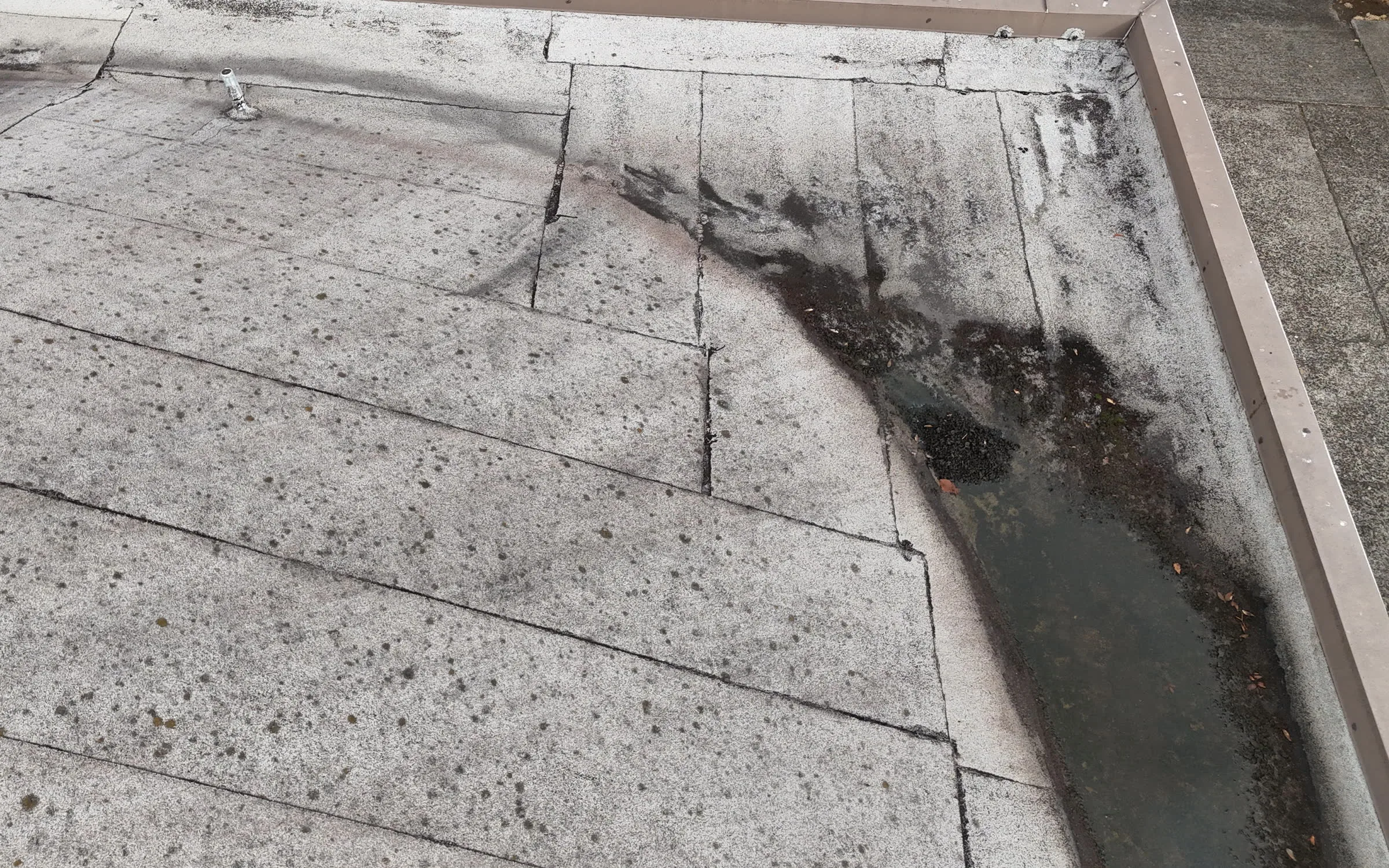
What to do: clear the nearest outlet and the debris, and pull the plants off the edge; their stems trap leaves where the water needs to leave. If the corner still holds water once the outlet is clear, it sits low, and fixing standing water like that is a repair, not a cleaning.
Why clear the roof twice?
Because most of the leaves haven’t fallen yet in October. The city’s Leaf Day street sweeps cover the parts of Portland with the most big street trees, Northwest Portland among them. In 2026 they run there from November 19 to December 17. A roof cleared in October can have its drains covered again by December.
December is also Portland’s wettest month. NOAA’s 1991–2020 normals put it at 5.77 inches at the airport, against 0.51 in July.
How to check your own roof
Look a day or two after it rains. A puddle gone by then is normal; water still there after 48 hours isn’t draining.
You may see part of the roof from an upper window, a taller wing or the building next door. From a roof hatch, look from the ladder; don’t walk out onto a wet roof. Look for:
- leaves or dirt piled at the drains, gutters, edges or corners
- water standing anywhere
- dark patches or rings: dirt left where water stood and dried
- plants or branches reaching over the edge
- ridges or wrinkles in the roofing, or a patch lifting at a corner
Inside, the signs come later: a stain on a top-floor ceiling, or water running down an outside wall below a gutter.
What each fix is, and what it costs
- Leaves, dirt or plants at the drains, gutters and edges: a Roof Service visit. A technician clears the drains, scuppers and gutters, hauls off the debris and seals small cracks. $395 for 2 hours of work, sealant and small patches included.
- Lifted seams, or a patch lifting at a corner: probed on the same visit. A small opening can be sealed then; a longer one is a Roof Repair, quoted for the job.
- Water still standing once the drains are clear: the spot sits low, or something holds the water back. That is a Roof Repair too.
- Many old patches, or you want to know how long the roof will last: a Roof Report: a drone map, a walk-on inspection and a core sample, opening with the roof’s years left and its repair and replacement budgets. $395 up to 30,000 sq ft, then $0.01 per extra sq ft.
- Water coming through a ceiling: stop the leak first. Flat roof leaks: what a Property Manager needs to know covers the first steps.
Planning a reroof on an older brick building?
None of the 12 roofs we flew looked like it needed one. If yours ever does, check two city rules first.
Unreinforced brick. On an unreinforced masonry (URM) building, City Code 24.85 counts removing more than half the roof covering within five years as a roof replacement. Then the roof has to be anchored to the walls and the parapets braced to an earthquake standard, one more reason to repair worn sections while they’re small. A structural engineer can confirm whether yours is URM, and does a new roof require an earthquake upgrade in Portland? covers the rule in full.
Historic districts. Much of the area around NW 21st and 23rd Avenues is the Alphabet Historic District. There, a reroof “using the same type of materials” counts as maintenance, exempt from historic resource review. Switching materials may need that review, so ask Portland Permitting & Development first.
Can’t see your roof?
Whatever your roof needs, the first step is seeing it. A flat roof behind a parapet can’t be seen from the street, and often not from anywhere in the building. A free Drone Check shows it to you: we fly a drone over the roof and send you photos and a short summary of what we see, like the ones on this page, but of your own roof. It can’t tell whether a seam is still sealed or where a leak gets in; that takes someone on the roof.
On these 12 roofs, the most common problem was also the simplest to fix: leaves sitting where the water needs to leave.
Thanks for your feedback.
About FRSG
Flat Roof Systems Group (FRSG) is a commercial flat-roof repair contractor serving Property Managers across Oregon and Washington. FRSG starts with a free Drone Check, fixes leaks and clears roofs with Roof Service, makes permanent Roof Repairs with clear documentation and predictable pricing, and proposes a Full Reroof only when repairing would cost more than it saves, with RoofCare to look after the new roof for up to 15years. Every repair ends with a Service Record: the problem reported, the work done, and photographs of the roof as FRSG left it.