Article
We rode along with Octopus Restoration & Remodeling on a tree-strike claim
FRSG went with Jared Moreda of Octopus Restoration & Remodeling to a Portland house a tree had just hit, to see how a restoration contractor handles an insurance claim from the first walkthrough. Here is what he told the owner, and why it is the reason we recommend Octopus.
On October 8, 2026, a tree came down on a house in Portland. The owner called her roofer, Interstate Roofing, which had done her roof before. Interstate knew it would be an insurance claim and sent it to Octopus Restoration & Remodeling, the restoration general contractor it works with. The call reached Octopus late in the morning. By early afternoon, Jared Moreda, Octopus’s co-founder, was walking the property with the owner. Mark Gelman from FRSG went with him.
This one is a house, not a commercial building. We are publishing it anyway, because the way the claim runs is the same on a commercial property, and because it shows the handoff we want for our own customers when a roof problem turns into damage inside.
What the damage looked like
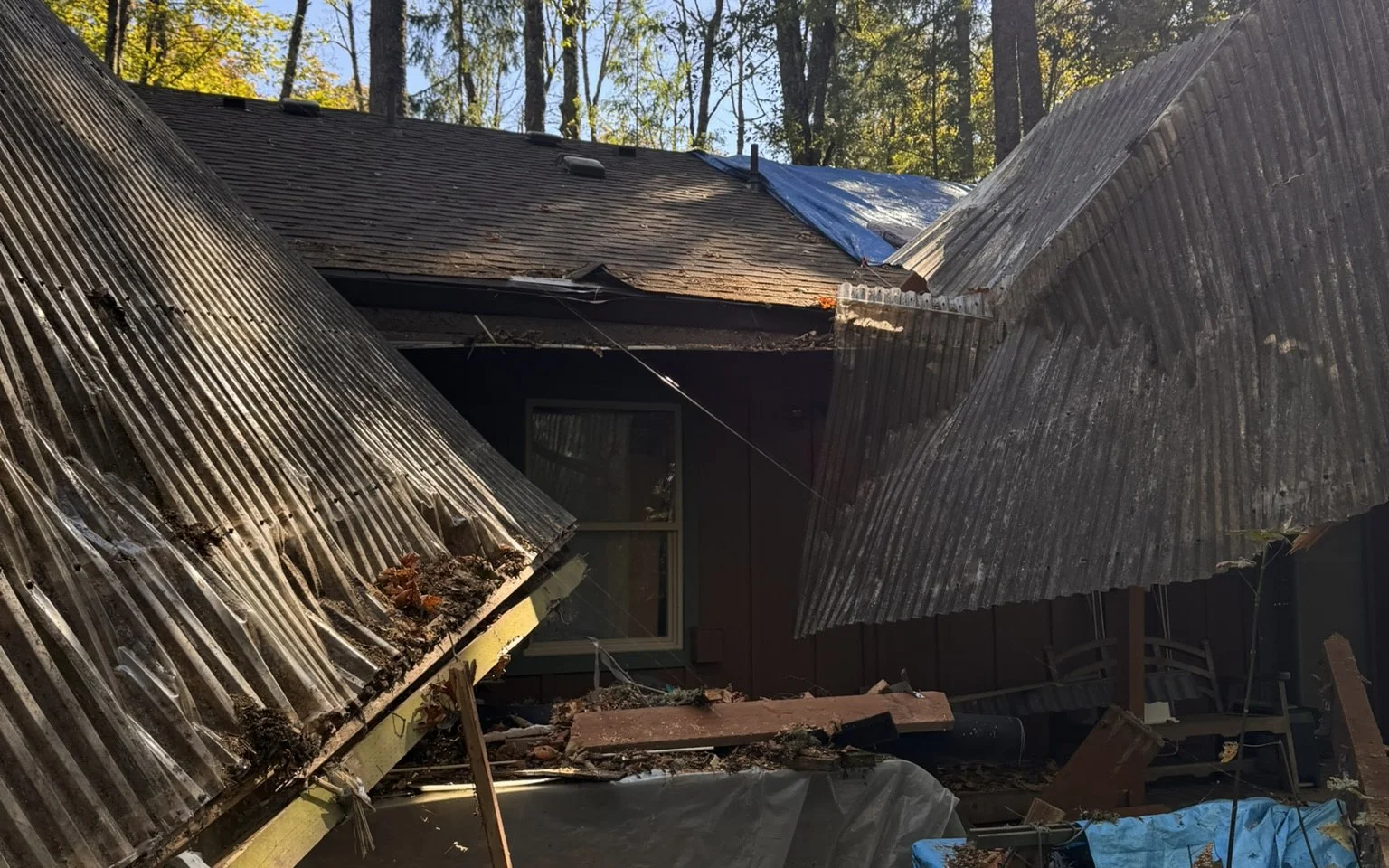
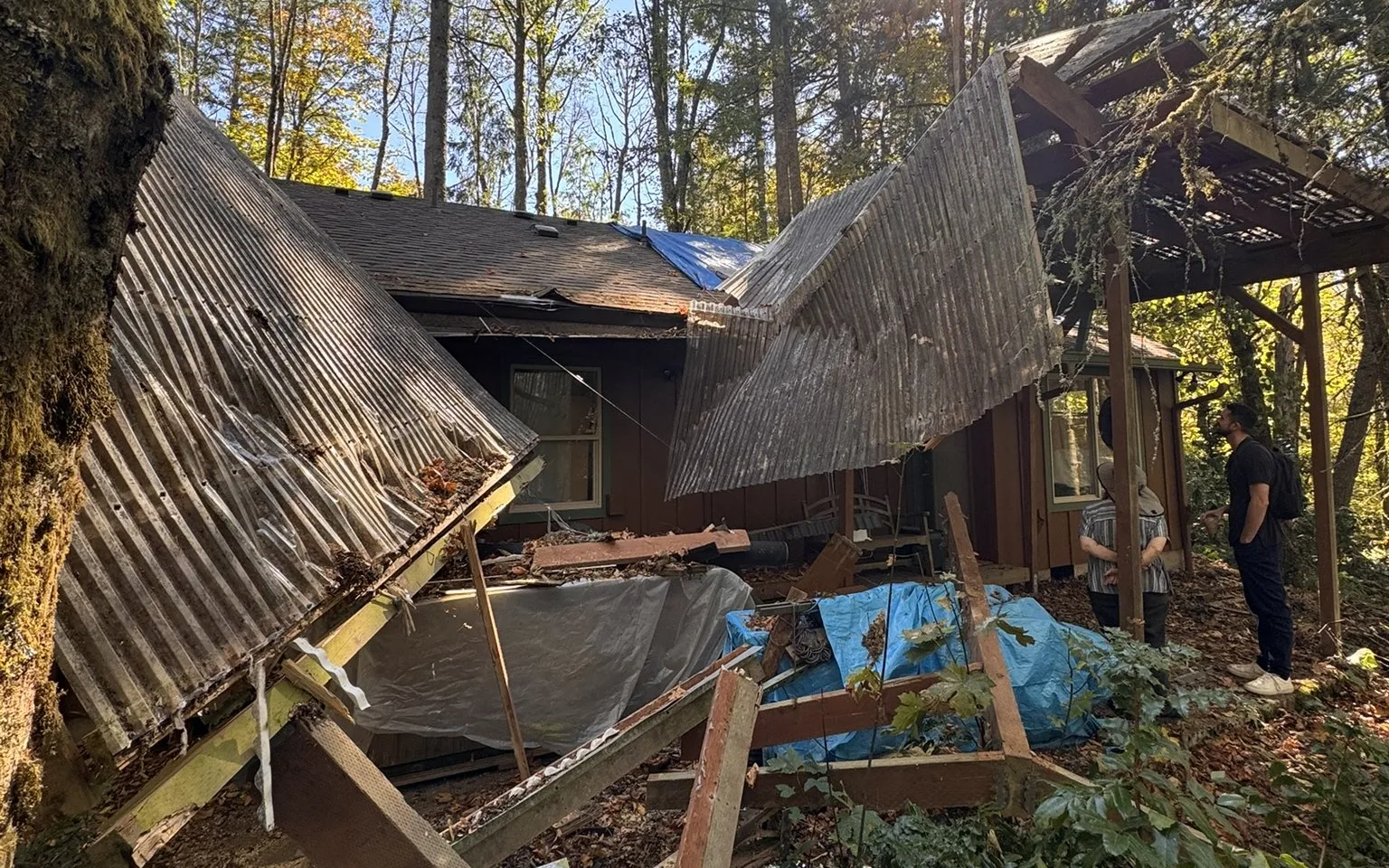
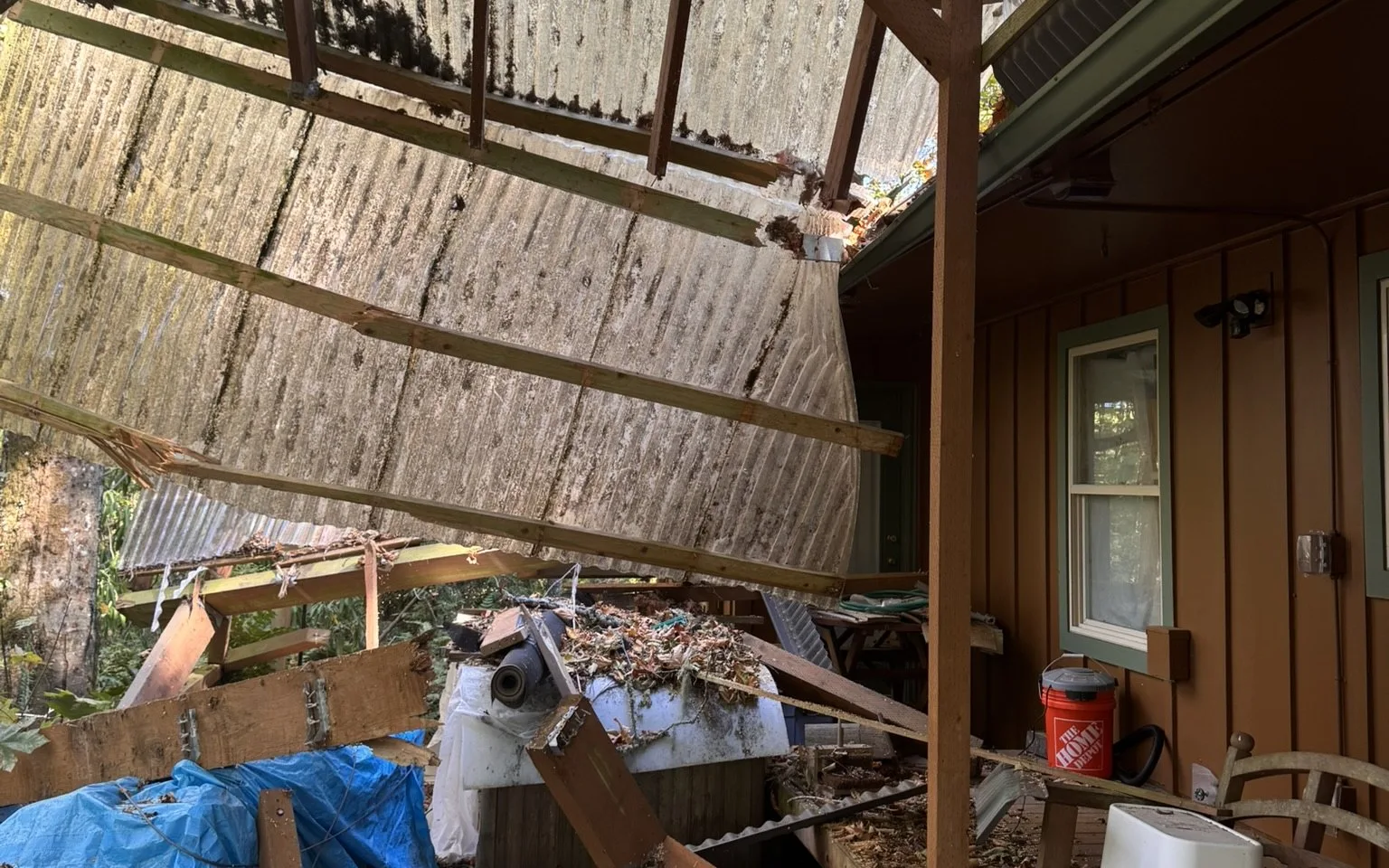
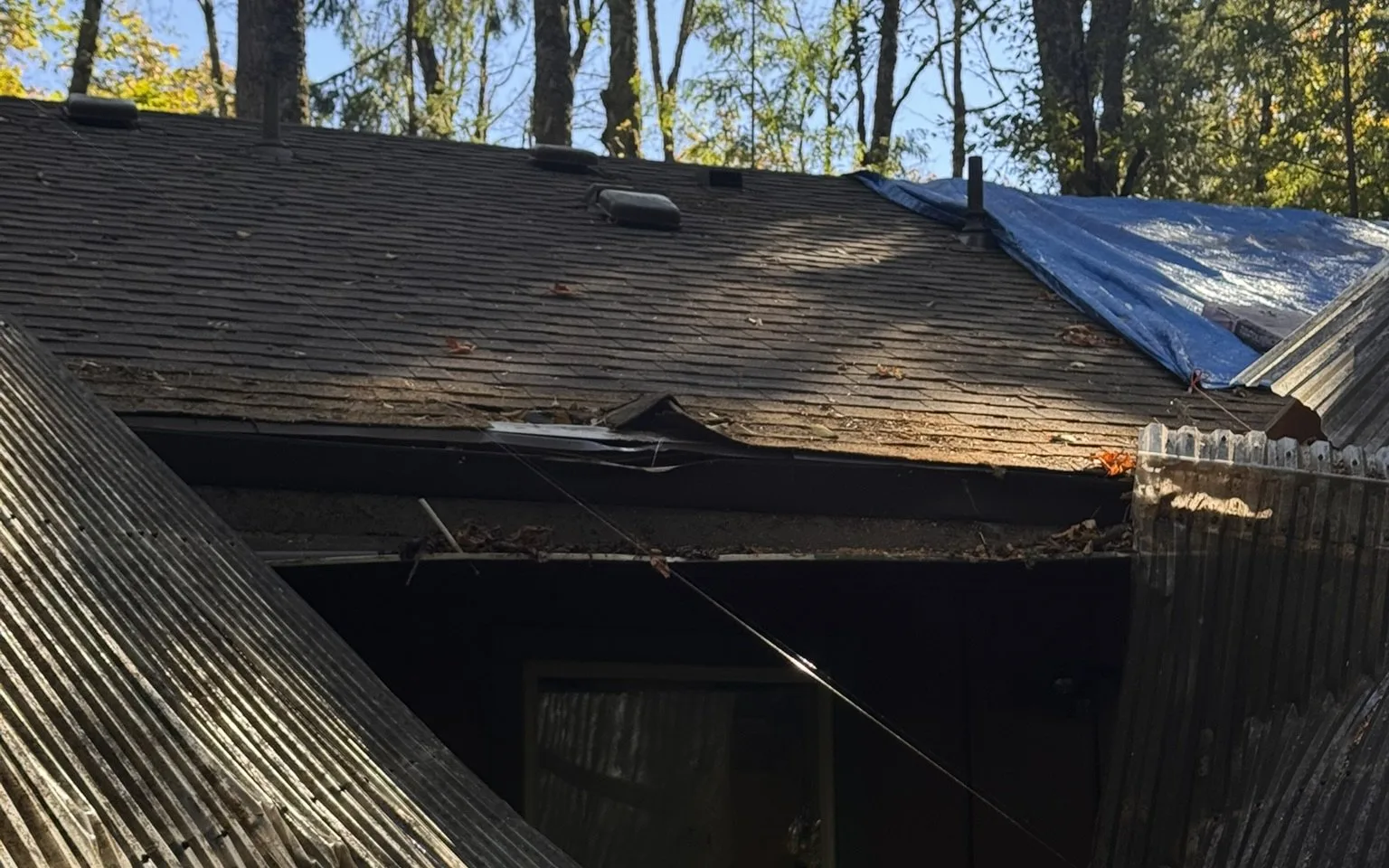
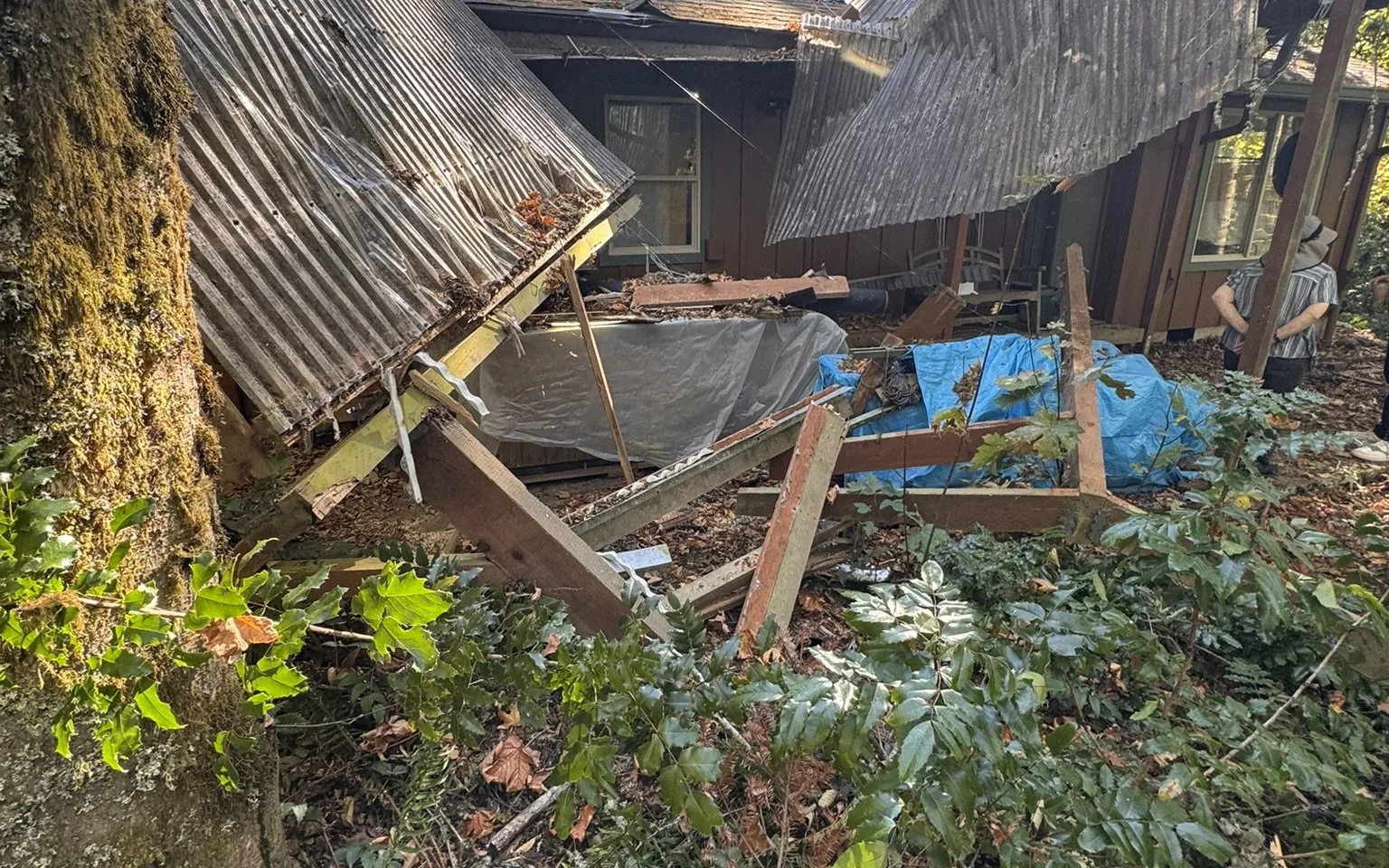
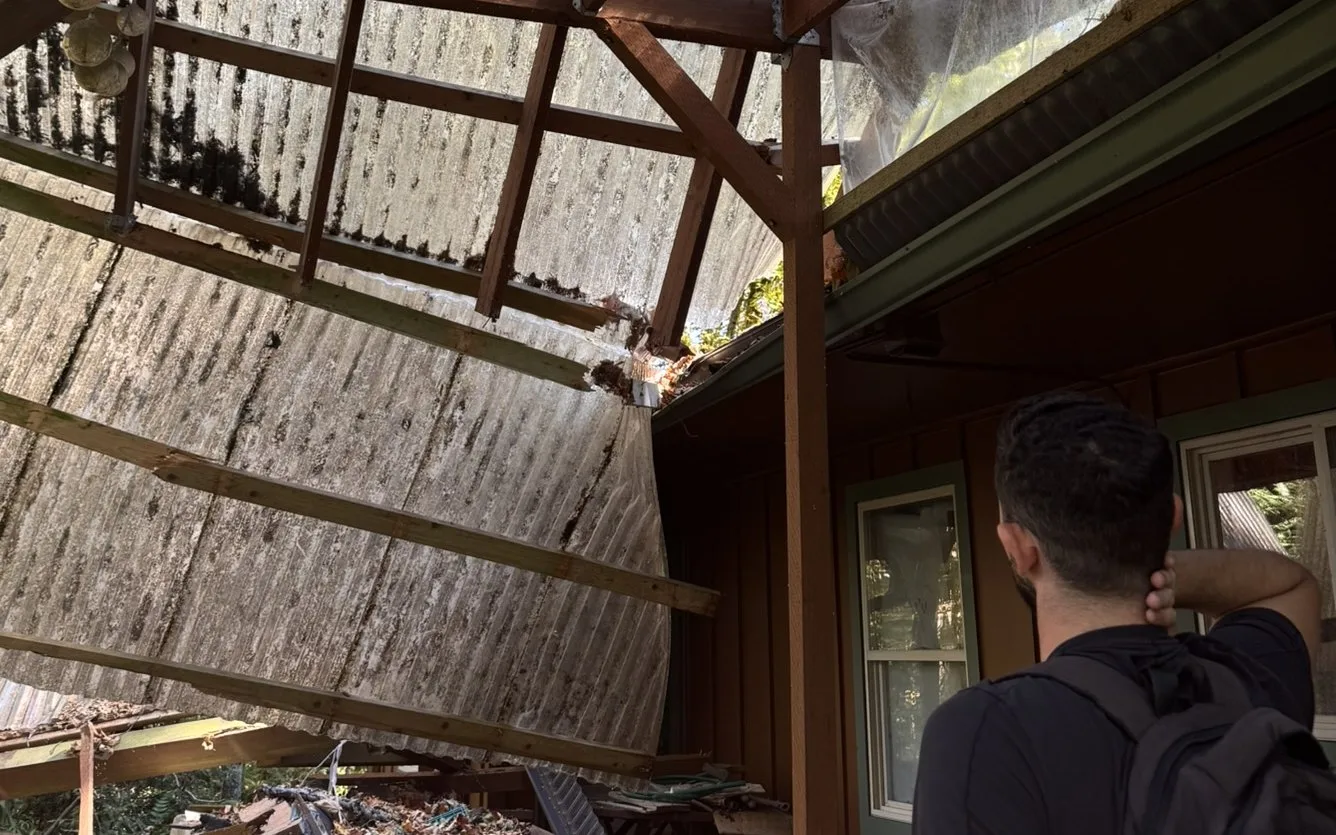
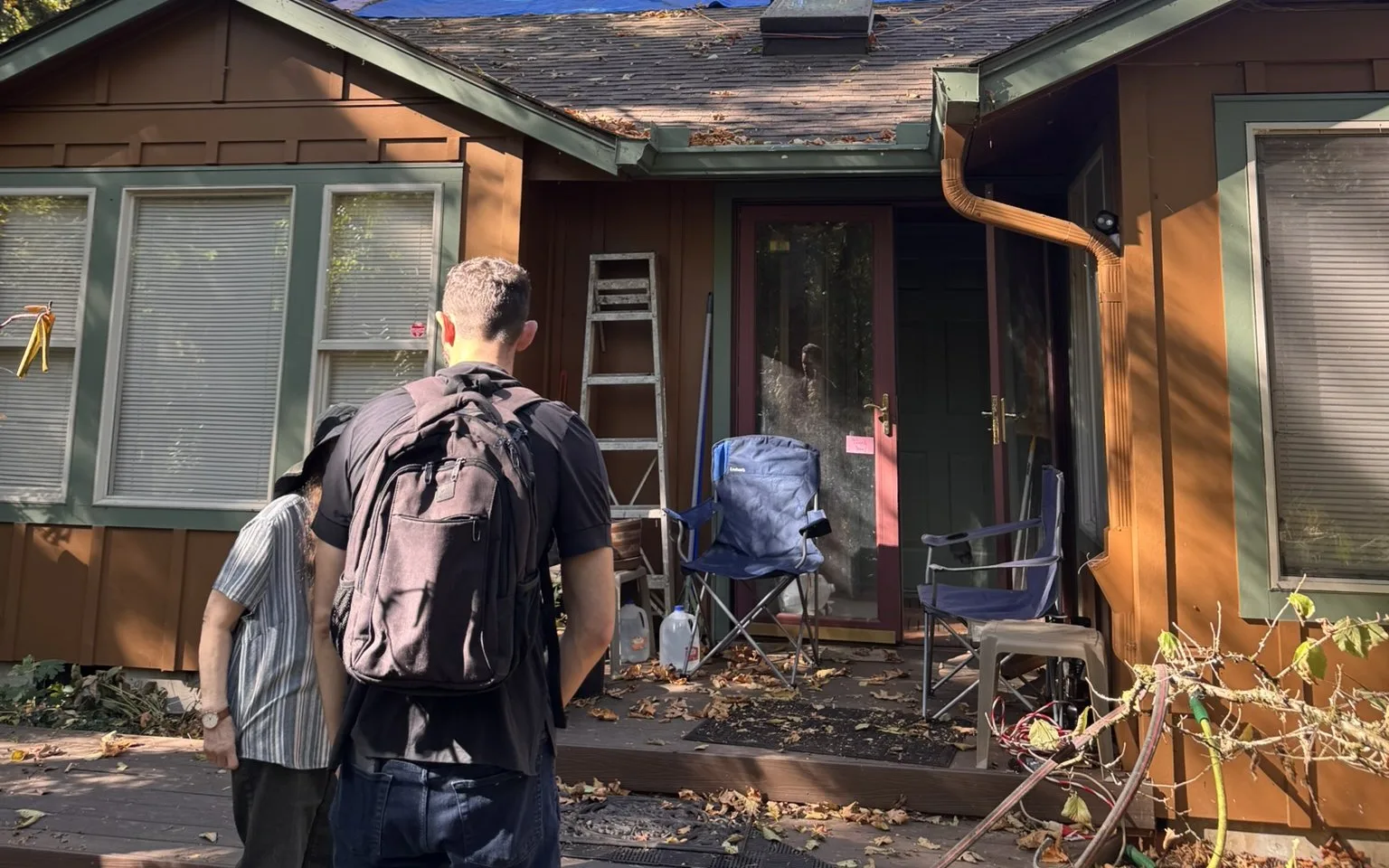
The house sits among tall firs at the end of a wooded road. When the tree came down, most of its weight landed on the covered patio, a frame of wood posts and beams carrying corrugated panels along one side of the house. The frame gave way and the panels folded down onto the deck. Part of the hit reached the main roof too. The gutter and eave along its lower edge were crushed, and part of the shingle roof needed covering.
By the time Jared arrived, the tree was off the house and that part of the roof was under a tarp. Behind the house, a fir still stands with its top snapped off. Mark photographed it all as they walked around.
We watched Jared take the job in the middle of our call
We were on a video call with Jared and Maya Weeks, who runs business development at Octopus, interviewing him for an article on what happens after a commercial roof leak. Partway through, Jared got a phone call from Interstate Roofing and passed it to Maya. “Maya, Interstate’s calling. Can you give Chris a call?” A few minutes later he told us that Interstate, a roofer Octopus works with, had just sent them a tree strike.
He did not end the call to go deal with it. He invited one of us to come along that afternoon so we could see the process for ourselves. “I don’t believe in gatekeeping this information like a lot of my competitors do.”
Behind that phone call is a routine. A new job at Octopus goes to one of four people in the office who log it in the job-tracking software the company runs on, where the location, photos and costs live from then on. During business hours the customer gets a call back within about an hour, and the job is triaged before anyone is sent. If a tree is still on a building, an arborist has to pull it before a tarp can even go on. This tree was already off and the roof was covered, so Maya set the visit for 1 to 1:30 that afternoon and emailed us the address. Mark drove out.
The person who shows up is the person who runs the claim
Jared went himself. He usually does. He is the first person from Octopus at most new losses, and he co-founded the company in 2023.
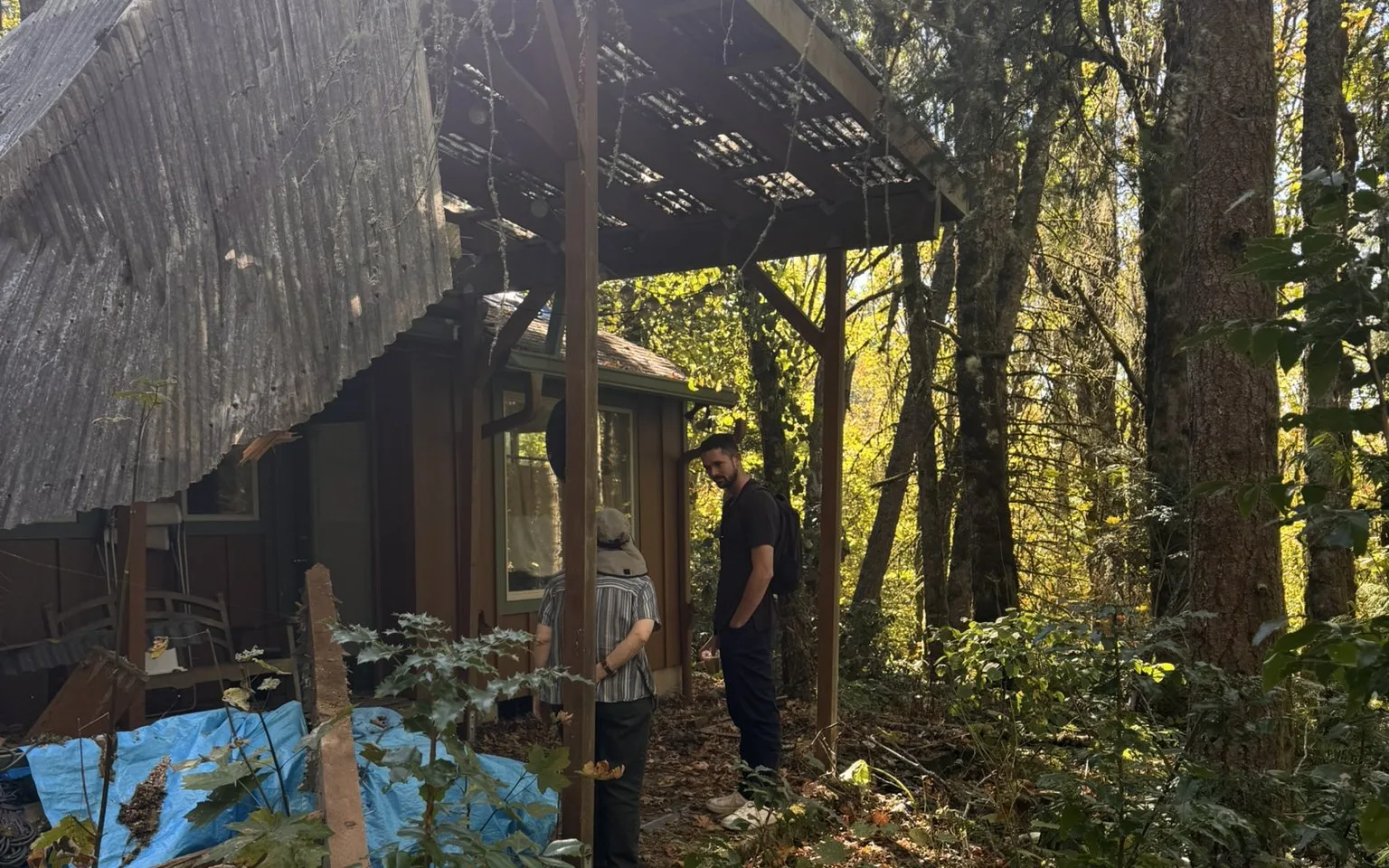
He did not come up through the trades. He grew up in Las Vegas, went to Arizona State, and moved to the Pacific Northwest with a desert kid’s view of the weather. “I hated the rain when I moved here and I found a way to make money off of it.” He learned construction by following two carpenters around for a full year, listening to how they talked about the work. “I tell people all the time I have soft hands.”
He describes the job as being a house doctor. He reads the damage, writes the plan, and assigns the carpenters and other trades who carry it out.
He looked for the damage the owner could not see
Anyone could see what was broken. The patio cover was on the deck. What Jared was looking at was the framing that was still standing, and the roof the tree had hit on the way down.
The roof framing is made of trusses, and a tree can crack them without anything showing from the ground. Until a structural engineer has looked, nobody knows whether this job is a new gutter and some shingles or new framing, so any price would be a guess. With the tarp keeping the rain out, there was no reason to guess, and Jared did not.
This is the moment these jobs usually go wrong
A damaged house, an owner under stress, and someone with a contract ready to sign. Jared sees it constantly. “In an environment where everything is on demand, we’ve been conditioned to sign the first thing that’s put in front of us and just get moving.”
The usual mistakes are a contract for the whole rebuild signed on the first day, a price written before anyone has checked the structure, and a contractor who does not know what the insurer needs, which leaves the owner paying for work the policy would have covered. Jared told us the same thing about commercial roof leaks when we interviewed him. Once the water is stopped, you usually have weeks to plan, not hours. Signing a contract for the whole rebuild on day one is, in his words, “signing away the farm.”
How Jared walked the owner through the claim
Jared did not have to work out the order on the spot. Tree strikes are routine work for Octopus, and he laid the claim out for the owner the way he has for others, on the first visit and before she signed anything. Every claim is different, but this order is one Octopus has run many times.
Step one: a structural engineer inspects the trusses. Jared told her the first call would be to an engineer, and that Octopus would set it up. Nothing would be priced until the engineer’s report came back, because that report decides how much of the structure gets rebuilt, what goes into the estimate, and what the carrier is asked to pay for.
Step two: the carrier reviews the claim and pays. Next, he explained, the engineer’s report and Octopus’s estimate go to the adjuster together, so the carrier sees the damage and the cost of fixing it side by side. Questions about the estimate come to Octopus, and the money comes once the carrier has what it needs.
Step three: Octopus runs the rebuild. Once the claim is paid, Octopus takes over as the general contractor. Jared was clear that he does not frame or roof himself. He brings in the trades the job needs, schedules them in order, and Octopus answers for all of it, carrying the liability and the warranty for everything that gets rebuilt.
Step four: the roof goes back to Interstate. Last, he told her the roofing would go back to Interstate, the roofer she had called first and the one that had done her roof before. It does that work as part of the same claim, under Octopus, so she would not be running a separate roofing job alongside the rebuild.
Octopus was straight with her about how a claim works
The owner already had contractors she trusted. Interstate had done her roof, and a different general contractor had done her siding. Wanting a company you already know on the job is a sensible instinct, so she asked whether that contractor and Octopus could share the work.
Jared told her plainly, before she signed rather than after, that an insurance claim does not work that way. The carrier works with one general contractor on a claim. That contractor writes the estimate, collects the documentation, answers the adjuster, and carries the liability and the warranty for everything that gets rebuilt. Two contractors splitting a claim means two estimates for the carrier to reconcile and nobody clearly responsible when something is missed.
The whole visit was built around the insurance claim
Rebuilding a patio cover is the easy part. Plenty of general contractors can do it. Far fewer know what an insurance carrier needs to see before it pays. It wants the engineer’s report, photos of the damage before anything is moved, and an estimate that lines up with both.
When a contractor does not know that, the claim comes up short, and the owner pays out of pocket for work the policy would have covered. So Octopus works in a fixed order. The photos, the engineer’s report and the estimate come first, and the demolition comes after. As Jared puts it, “Everything we do on the insurance side is so built around insurance documentation and providing photography and information. If you go out and do something and you don’t prove it, don’t expect to get paid for it.”
The roofer that sent this job has trusted Octopus as its restoration contractor since day one
Interstate Roofing has been Octopus’s largest referral partner since Octopus started. It is one of the oldest roofers in the Portland, Oregon area, and its ownership turned down referral fees from Octopus, asking that the money go to the customer instead.
A roofer that has been around that long does not hand its customers to a company it has not watched work. After this visit, we understand why.
What this looks like on a commercial building
This job was a house, but most of what Jared did carries over to a commercial building, and when we interviewed him he was specific about where it does not.
On a flat roof, stopping the water is what a LeakStop does, and once it is stopped the job slows down the way this one did. Jared calls roof leaks “very wait-and-see type calamities.” Once the tarp goes up, he told us, “we have weeks, if not months, to figure out what the plan is.” The exceptions are the same as on a house, a roof that has collapsed or a tree still on the building.
The hidden question moves inside. On this house it was the trusses. On a commercial building it is usually what the water reached below the roof, such as ceiling tiles, insulation and drywall, and in older buildings materials that need testing for asbestos or lead before anyone tears them out. Jared plans that from the roofer’s report. “If you can tell me exactly where the leak is coming from, I can plan around environmental testing,” he said. On a roof leak, the roofer’s photos of the leak and the rooms under it do the job the engineer’s report does on a tree strike.
The roof itself is not always part of the claim. Here the insurer is paying for the roof along with everything else, so Interstate’s work goes into the same claim. A flat roof that leaks because it has worn out is different. “The cause of loss is almost always the insured’s problem,” Jared told us, so the roof repair is often the owner’s cost, while the water damage inside may be covered. Your agent or adjuster can tell you which side of that line a leak falls on.
What stays the same is one contractor running everything inside. A Property Manager gets what this owner got, one company writing the estimate, answering the adjuster and carrying the warranty, instead of separate calls to a drying crew, a drywaller and a painter.
Commercial claims also carry less of the risk. Jared was blunt that the worst of restoration happens on houses. “In a commercial scenario, you’re way less likely to be taken advantage of.” The claims are bigger and the contracts more formal. When a commercial job does go wrong, it is usually over one of the two things this job got right. Either the damage was never photographed before it was moved, or someone signed a contract for more than the emergency needed.
Octopus is who we will be working with if you call us and need restoration in the Portland–Vancouver area
Thank you to Jared for bringing us along, and to Maya for setting it up on a few hours’ notice.
That afternoon is the reason this article exists. When a Property Manager calls FRSG about a leak that has already done damage inside, or a tree or storm that has hit the building, Octopus Restoration & Remodeling is the company you will be working with for everything inside. We stop the water and document the roof, and Octopus takes over from there, from the drying and testing to the claim and the rebuild.
We did not pick them off a list. We sat down with Jared and Maya, asked them how they work, and then watched Jared do it on a real job. So when we send you to Octopus, we know where you are going and who will pick up the phone, and Jared and Maya are people we can work with directly to get whatever your building needs done.
Common questions
Can I use my own contractor and a restoration company together on one claim?
Usually not for the same claim. The carrier works with one general contractor who writes the estimate and carries the warranty. That contractor can hire other trades, including your roofer, as subcontractors.
Why does a tree strike need an engineer?
Because the damage that decides the cost is often in the framing, not the shingles or panels you can see. An engineer’s inspection tells the contractor and the carrier how much of the structure has to be replaced.
Who removes the tree?
On a typical policy the tree itself is the cause of loss, and removing it is often the owner’s cost; the damage it caused is what the claim covers. Policies vary, so ask your agent.
Does the roofer who tarped the roof get to do the permanent roof?
It can. In this case, the owner’s roofer is doing the roofing as part of the general contractor’s claim.
Thanks for your feedback.
About FRSG
Flat Roof Systems Group (FRSG) is a commercial flat-roof repair contractor serving Property Managers across Oregon and Washington. FRSG starts with a free Drone Check, fixes leaks and clears roofs with Roof Service, makes permanent Roof Repairs with clear documentation and predictable pricing, covers roofs all year with RoofCare, and proposes a Full Reroof only when repairing would cost more than it saves. Every repair ends with a Service Record: the problem reported, the work done, and photographs of the roof as FRSG left it.