Article
Why does my flat roof only leak in wind-driven rain?
Wind drives rain sideways, and even uphill, into wall flashings, metal joints, roof edges, windows, and siding that calm rain barely reaches. A roof can leak in a storm where it would not leak otherwise.
Because wind puts water where calm rain never goes. In a still rain, water lands on the membrane and runs to the drains, and the walls, flashings, and metal joints above the roof only see what trickles down them. Storms often bring high winds, and wind drives rain sideways into those joints. It can even push water uphill under laps that shed water perfectly well the rest of the year. So the roof leaks in a storm where it would not leak otherwise, and a weak spot that lets in a little water in any rain lets in much more.
What wind does to rain
Rain that falls straight down mostly hits the roof. Wind-driven rain hits the walls as well, and it does not hit them evenly. The tops and edges of a building can take 20 to 30 times as much wetting as the middle of a wall. On a flat roof building, that top edge is the parapet, the metal cap on it, and the flashing where the membrane turns up the wall.
Wind also pushes. It creates a pressure difference across a wall that forces water through small openings, and the same pressure can drive water uphill. A metal lap or a flashing edge that sheds water by gravity keeps a calm rain out. In a storm, the wind pushes water back up underneath it.
In Oregon, most destructive winds come from the southwest, according to the National Weather Service in Portland. The south- and west-facing walls and parapets of a building usually take the worst of a storm.
Where the roof meets the wall
The joints most exposed to wind-driven rain are where the roof meets something vertical.
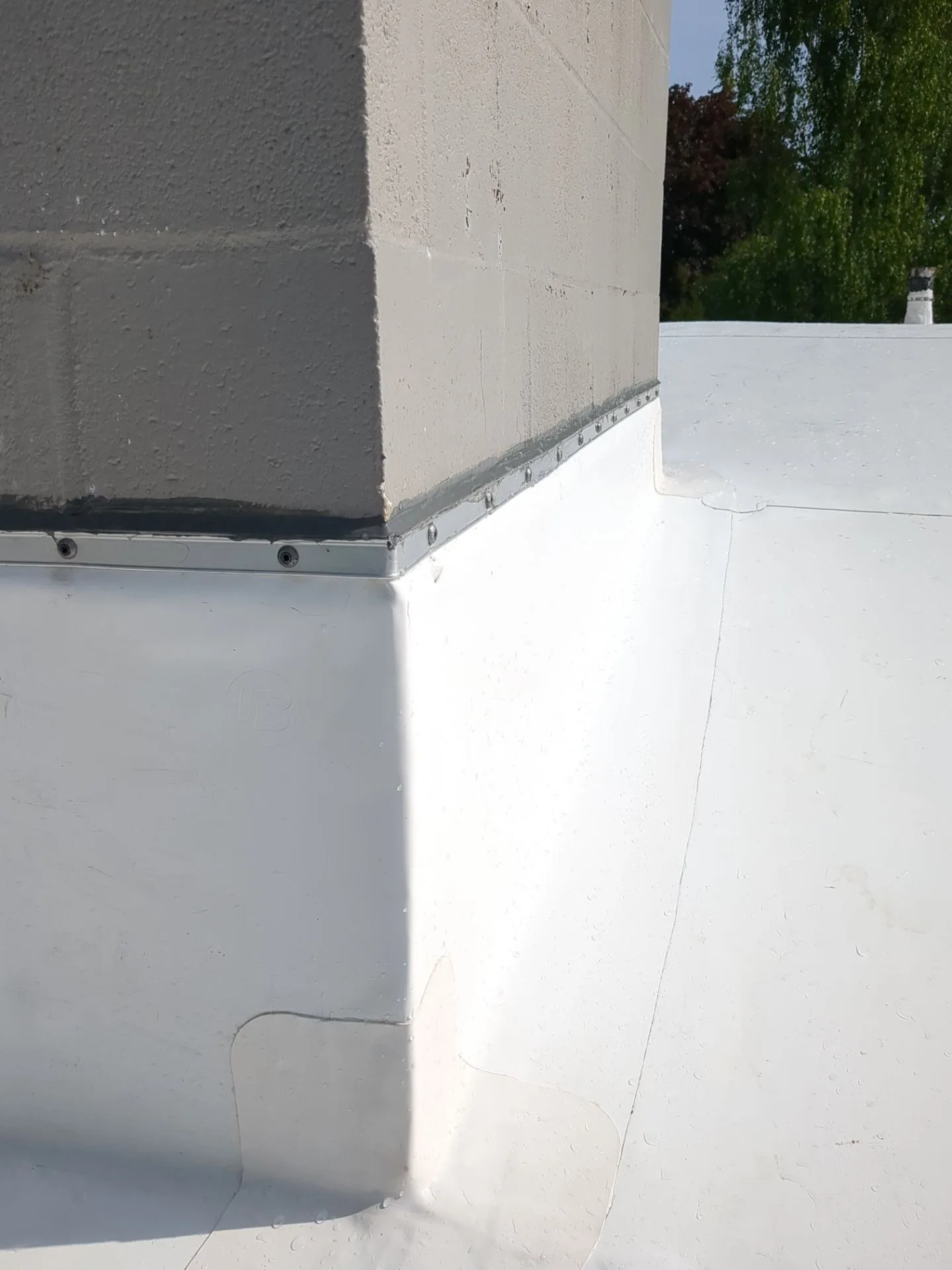
On a sound wall connection, the membrane runs up the wall and a metal termination bar is screwed along its top edge to hold it tight. A bead of sealant closes the gap between the bar and the wall. Calm rain runs down the wall, over the bar, and onto the membrane. Wind-driven rain hits that top edge head on. If the sealant has cracked or pulled away from the masonry, the wind pushes water behind the membrane, and it runs down inside the flashing to the deck.
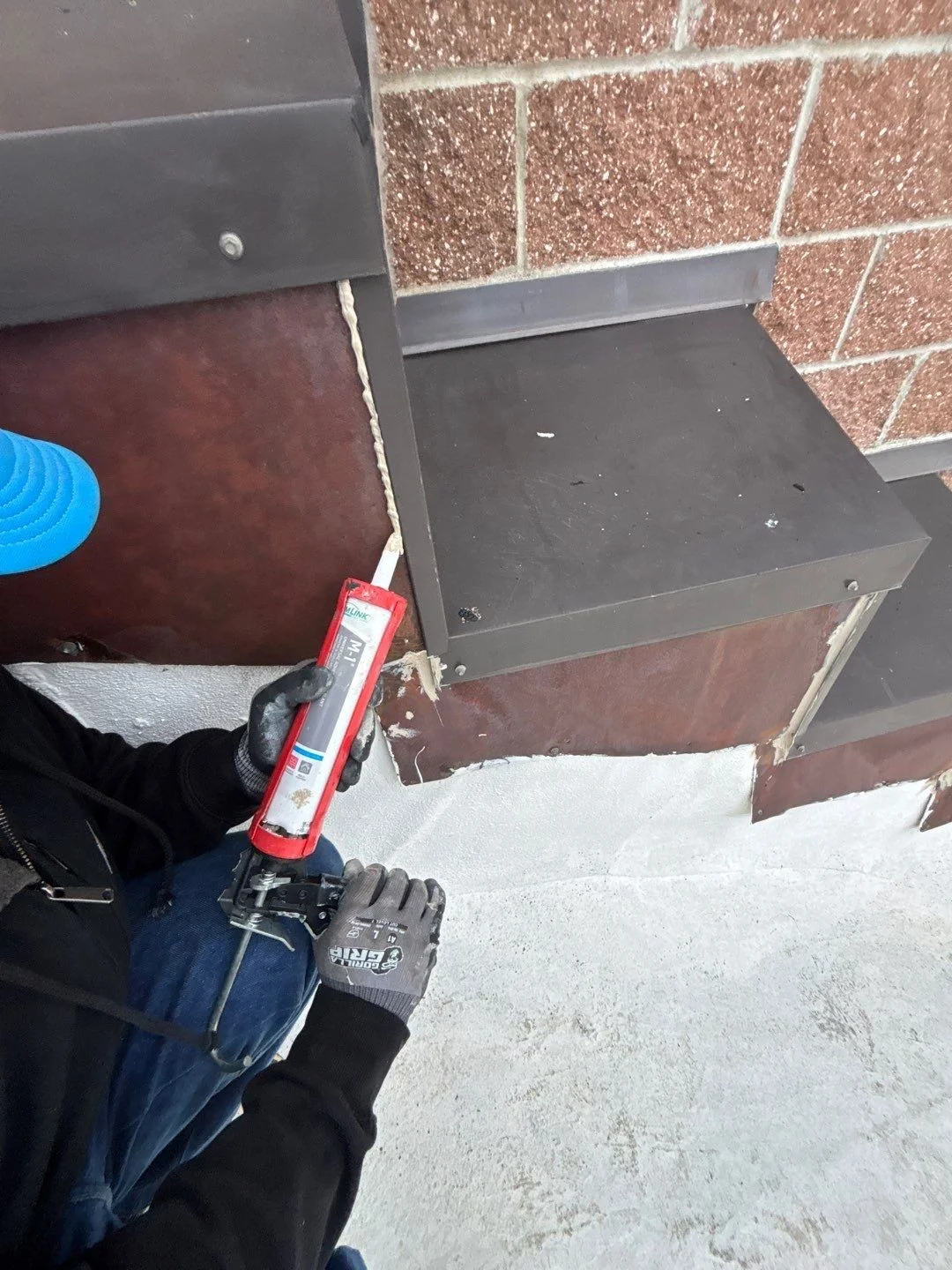
Metal flashings and caps are the other common entry. They come in sections, and each joint between sections is lapped or sealed. On a stepped wall like the one at the top of this page, every step has a vertical joint open to the weather, and wind-driven rain finds the ones that have opened up. Resealing them is a routine repair. The harder part is knowing which joints are letting water through.
Separation at the roof edge
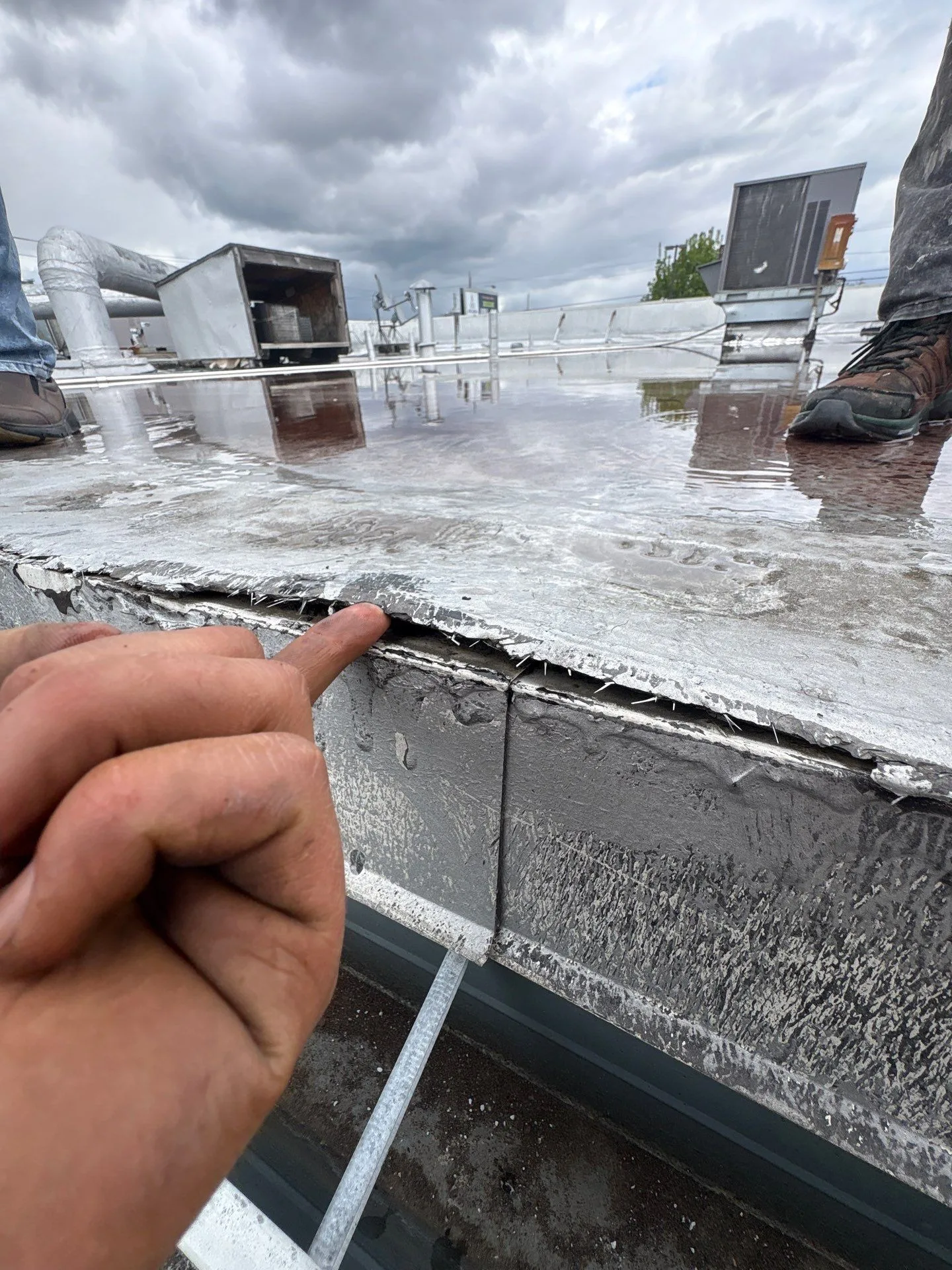
Along the perimeter, the roofing is sealed down over a metal edge flashing, and over time the two can pull apart. A gap like the one below can leak in any rain. Wind makes it much worse. It blows water straight into the opening, and it pulls on the edge itself: wind uplift is severe at the roof perimeter, especially at corners. A storm can lift a loose edge a little further and leave the gap wider than it found it.
Sometimes it is not the roof at all
Wind reaches the whole wall, not only the top of it. Windows, siding, trim boards, and scuppers (the openings that drain water out through a parapet) can all let water in during the right storm. Water that gets in at a gap around a window can run down behind the membrane and come through at a plywood joint in the deck about three feet away. From inside, that looks exactly like a roof leak.
We have seen roofs where one roofer after another caulked every seam and the leak kept coming, because the water was getting in through the siding. The membrane was fine the whole time. More sealant on the roof cannot fix a wall.
Why the stain inside so often ends up away from the entry is covered in Why does my flat roof keep leaking in the same spot?
Proving the membrane is sound
Before anyone blames a wall, the membrane has to be ruled out, and that is quick to show. We run a hook or the back of a knife along the seams. On a welded membrane, a sound seam gives the tool nothing to catch on, and an open one lets it slip in. When the seams hold and the leak only comes with the wind, the search moves up and out: the top edge of the wall flashing, the joints in the metal, the roof edge, and the windows and siding on the side of the building that faced the storm.
What the timing tells you, and what it doesn’t
A leak that shows up only in windy storms, or gets much worse in them, narrows the search. It points to something the wind reaches and calm rain barely does: a vertical surface, a top edge, a roof edge, or a joint facing the weather.
It does not name the joint. Wind direction alone cannot tell you whether water got in at the flashing, the window above it, or the siding beside it, because the same storm hits all three. A storm also brings more than wind. It brings more water, and leaves and debris that can partly block a drain, so water stands deeper on the roof than usual and reaches seams and flashing edges it normally doesn’t. A seam that has started to open can hold in a light rain and leak in a heavy one.
So a windy-storm leak is a strong clue, not a diagnosis. Someone still has to find the opening.
What to tell your roofer
A few observations make that search shorter. When you book a Roof Inspection with us, a roofing specialist calls you the same business day to arrange access to the roof (the next business day if you book after hours). That call is the time to pass these on:
- Which storms. Every rain, or only the windy ones? If a steady all-day rain with little wind stays dry inside, say so.
- Wind direction, if you know it. Local weather reports record it, and it tells the roofer which walls took the rain.
- Timing. How long after the rain started the drip began, and whether it stopped with the rain or kept going for hours.
- Where inside. The room, how far it is from the nearest exterior wall, and which wall that is.
- Photos. Snap a few on your phone: the stain, and the outside of that wall.
- Past repairs to that part of the roof or wall, and who did them.
Keep it simple. A few phone photos and your best memory of when it leaks are plenty. You can book a Roof Inspection here.
Thanks for your feedback.
About FRSG
Flat Roof Systems Group (FRSG) is a commercial flat-roof repair contractor serving Property Managers across Oregon and Washington. FRSG stops active leaks, makes permanent Roof Repairs with clear documentation and predictable pricing, and proposes a Full Reroof only when an inspection shows that repairing would cost more than it saves. Every visit ends with a Service Record: the problem reported, the work done, and photographs of the roof as FRSG left it.