Article
What should I do when several rooms are leaking?
Handle all the rooms as one job: put a bucket under every drip, note where each one is, book one visit for all of them, and make sure someone can let the technician in. Several wet rooms do not mean several holes in the roof.
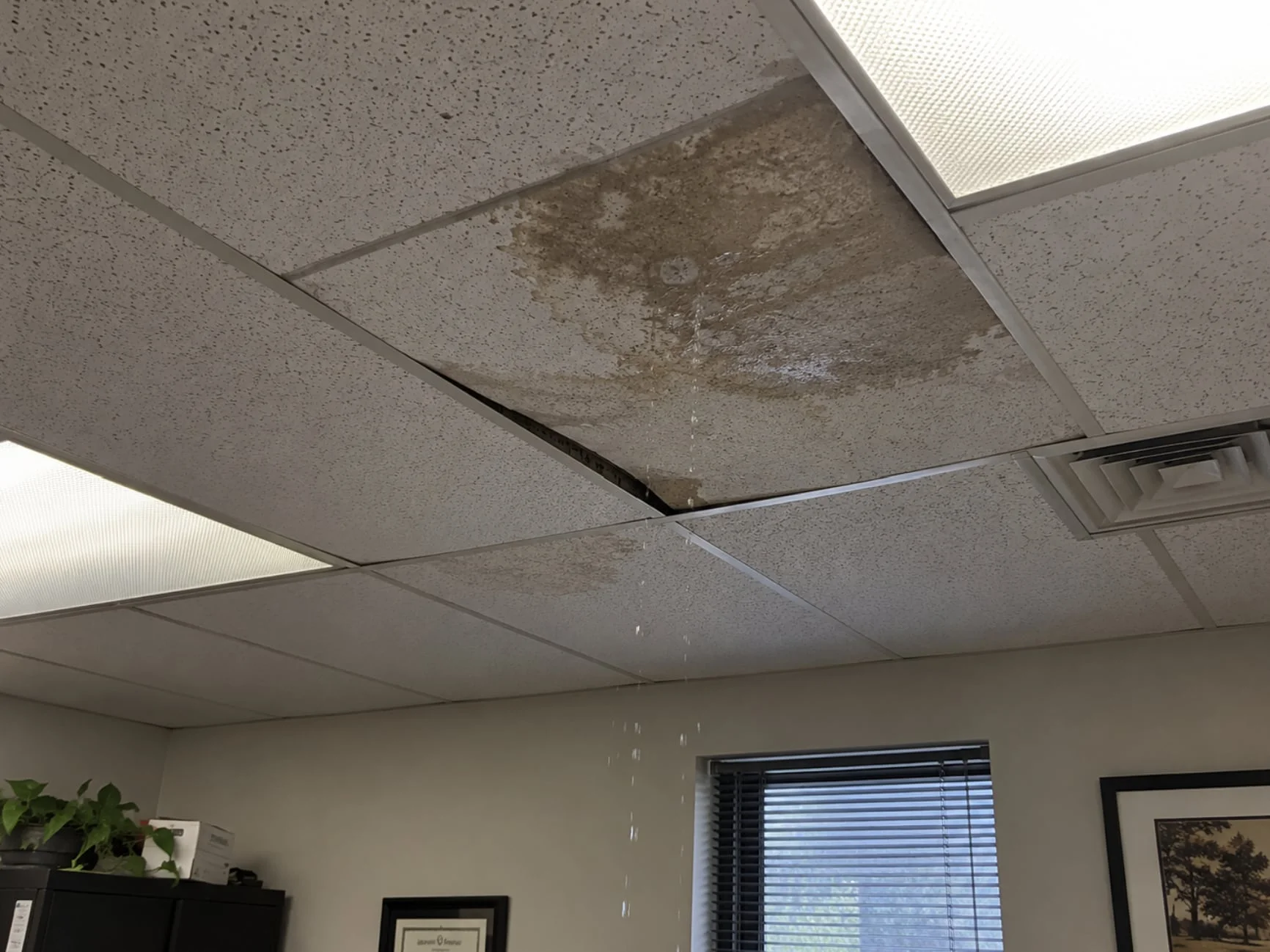
Handle all the rooms as one job:
- Put a bucket under every drip.
- Note where each one is, so the technician knows where to look.
- Book one visit for all of them.
- Make sure someone can let the technician in.
The number of wet rooms is not the number of holes in the roof. Water travels under the roofing, so one opening can wet several rooms. Finding where it gets in is the roofer’s job.
Catch the water in each room first
Put a bucket or bin under every drip. Move what you can out from under it: computers, files, stock.
If water is pooling in a drywall ceiling and making it sag, let it out on purpose. Our roofer’s advice is to puncture the sheetrock where it sags, take out the wet insulation, and put a bucket underneath. Water that drains into a bucket stops spreading across the ceiling.
Skip the tarp. Nothing sticks to a wet flat roof, so a tarp up there does little. Your time is better spent inside.
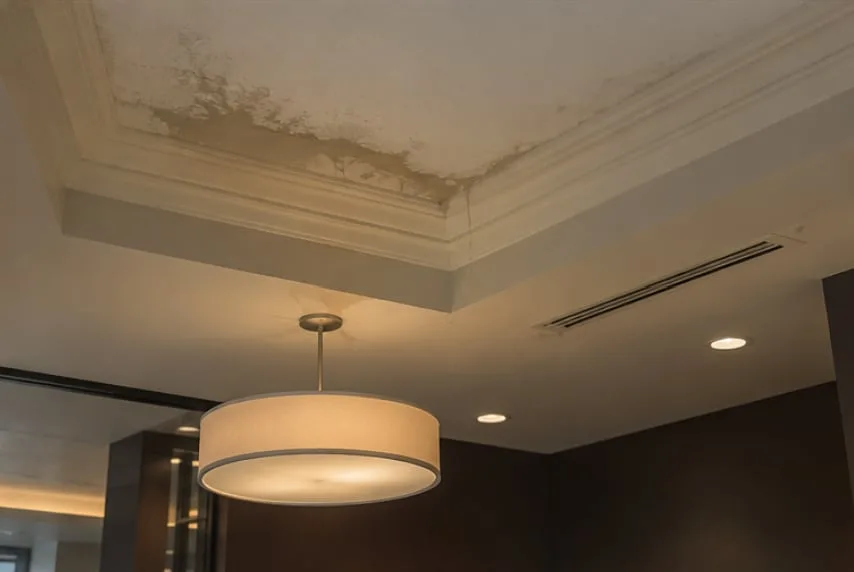
Water near a light fixture, outlet, or panel is a different job. Keep people away from it, and leave it to whoever handles your electrical. OSHA’s electrical safety guidance is to have a qualified electrician check wet electrical equipment before it is turned back on.
Know where each spot is
You do not need to write anything up. Just know which rooms are wet and roughly where in each room: by the window, over the copier, in the back corner. When the technician gets there, they know where to look.
A quick photo of each spot helps too. What photos should I send a roofer about a leak? covers what makes a photo useful.
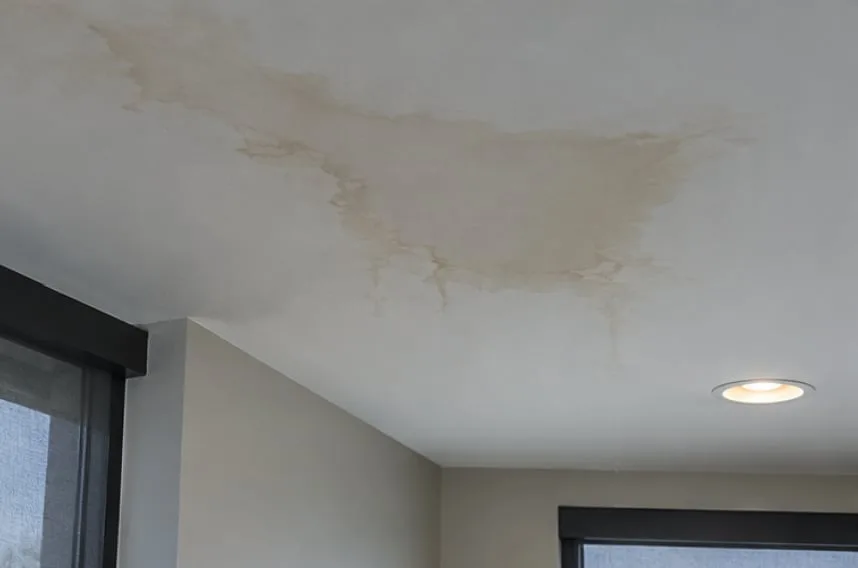
Several rooms, maybe one opening
Water that gets through the roofing does not fall straight down. It runs under the roofing and along the plywood deck. It comes through where two sheets of plywood meet, sometimes several feet from where it got in.
That is how one opening wets two rooms. It also works the other way: one room can have water from two openings.
So the number of wet rooms does not tell you how many problems the roof has. Our roofers check the spots inside first, then go up and trace each one back to where it gets in. Why does my flat roof keep leaking in the same spot? explains how water travels.
Book one visit for every room
Roof Service sends a technician to find where the water gets in and seal it. One visit covers every wet room, so book once. You do not need one visit per room, and there is no charge per spot.
$395 covers the first 2 hours of work, with sealant and small patches included. If stopping every spot takes longer:
- Extra time is $125/hr, billed in half hours.
- Bigger materials are billed at cost + 15%, with receipts on request.
- The technician asks first. Extra time and bigger materials are always confirmed with you before the work.
If water is coming in now, choose Within 6 hours when you book: a technician on your roof within 6 hours, day or night, for $250 more.
After you book, you get a call within 2 hours. Tell us about every spot, including small ones. The technician starts with the spots you report.
Make sure someone can let the technician in
The easiest way is to have someone on site when the technician arrives. It can be you, a tenant, or a building engineer, anyone who can show them the wet rooms.
If no one can be there, just tell us how to get in: a lockbox code, a key at the front desk, or a person to call. You can tell us on the call after you book.
When a spot changes
Leaks change while you wait for the technician. A new spot shows up in another suite, or a drip stops.
Let us know when that happens. Mention the stopped ones too: a drip that stops when the rain lets up is still a leak.
If a new room starts leaking after you book, it is part of the same visit. Tell us on the call, or tell the technician. If it takes the work past the first 2 hours, the technician asks before going over.
After the visit
You get a Service Record of the visit: what you reported, what the technician did, before and after photos of each leak they worked on, and where things stood when they left.
Forward the Service Record to tenants and the owner, so everyone has the same account of what happened.
If the same rooms take water again in the next storm, that is a different problem. Why does my flat roof keep leaking in the same spot? covers why a leak comes back.
Common questions
Should I book a separate visit for each room?
No. One Roof Service visit covers every wet room. Book once, and tell us about every spot when we call.
Do more wet rooms cost more?
Not by the room. The price covers the first 2 hours of work. If stopping every spot takes longer, extra time and bigger materials are billed, and the technician asks before going over.
Does every wet room mean a separate hole in the roof?
No. Water runs under the roofing before it comes through, so one opening can wet more than one room. The roofer traces each spot back to where it gets in.
One unit is leaking. Are the others next?
Not necessarily. A leak shows where one opening is, not the shape of the whole roof. A Roof Report covers the rest: photos of the whole roof, with each finding marked on a map.
Do I have to be at the building?
Not if someone else can be. A tenant or a building engineer can show the technician the wet rooms. If no one can be there, tell us how to get in.
What if one of the spots is not a roof leak?
It happens. Water can come from plumbing, a wall, or a rooftop unit. A spot that shows up on warm, dry days while the air conditioning runs is often the HVAC unit, not the roof. If the technician finds water is not coming through the roof, they tell you where it is coming from.
Thanks for your feedback.
About FRSG
Flat Roof Systems Group (FRSG) is a commercial flat-roof repair contractor serving Property Managers across Oregon and Washington. FRSG starts with a free Drone Check, fixes leaks and clears roofs with Roof Service, makes permanent Roof Repairs with clear documentation and predictable pricing, and proposes a Full Reroof only when repairing would cost more than it saves, with RoofCare to look after the new roof for up to 15years. Every repair ends with a Service Record: the problem reported, the work done, and photographs of the roof as FRSG left it.